








Looking to boost your app's visibility and acquire more users? Our 2025 ASO Report is your ultimate guide to navigating the evolving app store landscape. Packed with data-driven insights, keyword trends, and top-ranking app strategies, this report will equip you with the knowledge to optimize your app's presence and achieve organic growth.
What is the minimum detectable effect (MDE)?
Minimum detectable effect (MDE) is a core concept in A/B testing and experimentation. If you run product tests, pricing tests, or mobile app store experiments, you will rely on MDE to understand whether your test can detect a meaningful change.
In this glossary article, we explain what MDE is, why it matters, and how you can select the right value for your tests.
Minimum detectable effect (MDE) meaning
The minimum detectable effect (MDE) is the smallest change your A/B test can reliably detect. It represents the minimum effect size that must occur in the experiment for you to identify that the variant performs differently from the control.
In simple terms: If the true lift is smaller than your MDE, your test may not detect it.
MDE is used in:
- A/B testing
- Mobile app experiments (store listings, paywalls, onboarding, pricing, etc.)
MDE mean in A/B testing is the smallest improvement (or drop) in your chosen metric, such as conversion rate or install rate, that you can detect with statistical significance.
Why MDE matters in experiments
MDE is important because it directly shapes how your A/B test behaves. It affects:
- Sample size: A smaller MDE requires more users. A larger MDE requires fewer users.
- Test duration: If your MDE is too small for your traffic level, the test will take too long or never reach significance.
- Decision quality: If MDE is unrealistic, you risk missing meaningful changes or making decisions with weak evidence.
In practice, choosing the right MDE helps you balance accuracy, speed, and resource usage. For mobile apps, this is especially important because install volume and user cohorts vary by country and season.
Absolute vs relative MDE
You can express MDE in two ways.
Absolute MDE
This shows the direct numeric change.
Example: Increasing a 20% conversion rate to 22% (a +2 percentage point lift).
Relative MDE
This shows the percentage change relative to baseline.
Example: A 10% relative lift on a 20% baseline means an increase to 22%.
Relative MDE is more common in mobile experiments because it’s easier to compare across countries, cohorts, and funnel steps.
When to use which?
- Use absolute MDE when working with stable metrics like retention rate.
- Use relative MDE when evaluating growth metrics such as CVR, installs, or subscriptions.
Understanding the difference helps you avoid misinterpreting results or selecting unrealistic goals.
How to calculate minimum detectable effect (MDE)
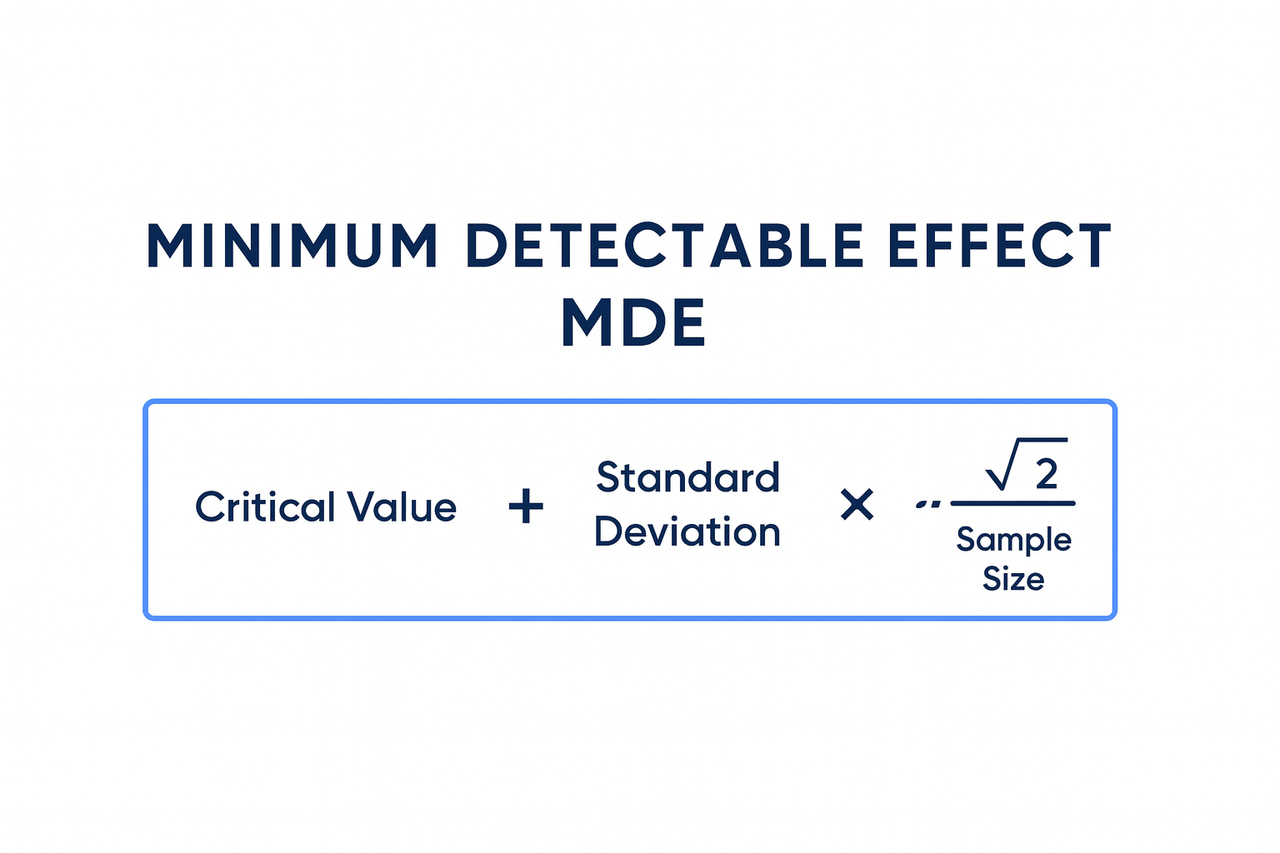
The minimum detectable effect formula relies on:
- Baseline conversion rate
- Expected variance
- Sample size
- Statistical power (typically 80%)
- Significance level (typically 5%)
In practice, you rarely calculate the full formula manually. Most teams use experimentation calculators.
MDE depends on how noisy your metric is, how many users you have, and how confident you want to be in your results.
If you keep power and significance fixed:
- More traffic → you can detect smaller effects
- Less traffic → you must detect larger effects (higher MDE)
Minimum detectable effect in A/B testing is the smallest relative or absolute change your experiment can detect based on your inputs above.
MDE vs statistical power
MDE and statistical power are linked:
- Lower MDE → higher sample size → higher power
- Higher MDE → lower sample size → lower power
If you want to detect small movements (for example, a 1% lift in install rate), you need strong statistical power and large traffic. If your traffic is limited, you must choose a larger MDE or run fewer variants.
For mobile app teams, this trade-off matters when running:
- Google Play store listing tests
- Apple product page optimization tests
- Paywall or onboarding experiments
- Subscription pricing tests
Choosing the right MDE ensures your tests remain feasible.
How to choose the right MDE
Here is a simple, practical approach for beginners:
- Look at your baseline metric (e.g., install conversion rate or purchase rate).
- Decide the smallest change that would matter to your business.
- Check whether your traffic volume supports detecting that change.
- If not, increase your MDE or reduce the number of variants.
Optimal MDE for mobile app A/B tests: Most teams choose an MDE between 5% and 15% relative lift, depending on traffic. Apps with low daily install volume often need higher MDE values.
Frequently asked questions
What is a good MDE?
Choose an effect that is meaningful for your business and achievable given your traffic. Many teams start with a 5–15% relative lift.
How does MDE affect sample size?
A smaller MDE requires a larger sample size. A larger MDE reduces sample size needs.
Is MDE the same as effect size?
MDE is a detectable effect size. Actual effect size is the true change in your metric.
Related terms
Looking to boost your app's visibility and acquire more users? Our 2025 ASO Report is your ultimate guide to navigating the evolving app store landscape. Packed with data-driven insights, keyword trends, and top-ranking app strategies, this report will equip you with the knowledge to optimize your app's presence and achieve organic growth.
Grow your app on the App Store and Google Play Store with our solutions now