











Music
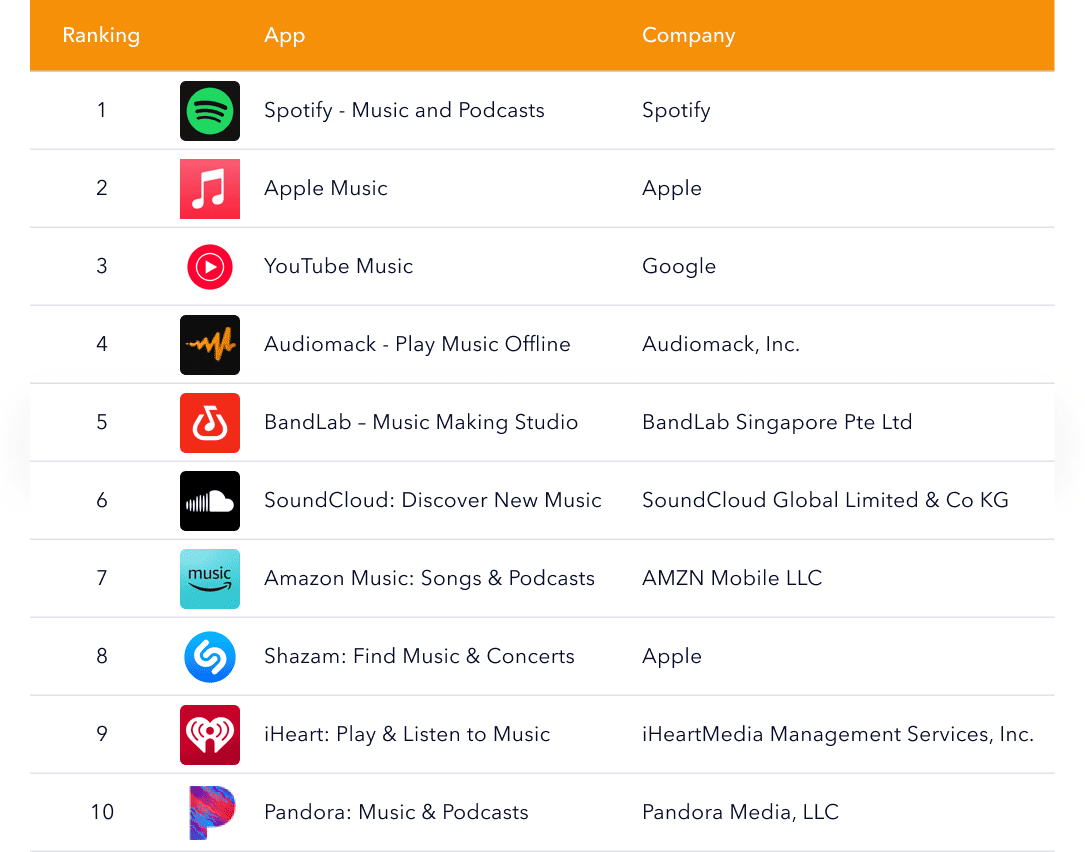
- Spotify is a streaming app for music, podcasts, and audiobooks, built around personalized playlists and on-demand listening. It performs strongly because its metadata leads with broad, high-volume terms like “music” and “podcasts,” then reinforces everyday actions such as “songs,” “playlists,” “stream,” and “download.”
- Apple Music is a streaming service centered on on-demand listening, curated playlists, and high-quality audio. It performs well in search due to strong brand demand and broad “music” intent, while its metadata adds a clear scale signal with the subtitle “Over 100 million songs.” The description reinforces this positioning with terms like “songs,” “playlists,” “stations,” and “download,” alongside quality cues such as “Spatial Audio” and “lossless,” which frame the app as a premium listening option.
- YouTube Music combines official songs with YouTube-native content such as live performances, covers, and remixes. It performs well in search because it serves both standard streaming needs and discovery-driven behavior, clearly communicating access to content that feels unique. Its metadata stacks broad keywords like “music” and “playlists” with differentiators such as “live,” “covers,” “remixes,” and “song lyrics,” expanding reach while keeping the use case clear.
- Audiomack is centered on discovering music and mixtapes, with a strong emphasis on offline listening. It performs well because “offline” is a high-intent need for users with limited connectivity or frequent travel, and the app name directly answers that use case. Its metadata leads with “play music offline” and reinforces core behaviors like “stream,” “playlists,” and “downloads,” supporting both relevance and conversion on offline-focused searches.
- BandLab is a mobile music creation app. It performs well because it targets creation-focused searches that sit outside traditional streaming intent. Its metadata uses direct creator language such as “record,” “make beats,” “mix,” and “mobile studio,” clearly signaling the product and improving match quality for creator-driven searches.
- SoundCloud is known for music discovery, emerging artists, DJ sets, and remix culture. It performs well in search by owning a strong discovery position that appeals to users looking beyond mainstream catalogs.
- Amazon Music offers music and podcast streaming with both free listening and paid tiers connected to the Amazon ecosystem. It performs well in search by covering broad “music” and “podcasts” intent while clearly framing access options for different user needs. Its metadata repeats high-volume category terms such as “songs,” “podcasts,” and “listen free,” keeping it eligible across mainstream discovery queries.
- Shazam is a music recognition app designed to identify songs playing nearby or within other apps. It performs well because “identify song” is a clear, utility-driven search intent, and the promise is instantly understood.
- iHeart is a radio-first listening app offering live stations alongside podcasts and playlists. It performs well in search because “radio” remains a strong and habitual listening behavior, especially for commuting and local content.
- Pandora is a music and podcast app centered on personalized stations and radio-style listening. It performs well in search because its metadata clearly combines broad terms like “music” and “podcasts” with intent-specific words in the subtitle, such as “streaming” and “radio.” The description reinforces this with phrases like “stations,” “artists,” “genres,” and “discover,” which match common searches from users looking for personalized, lean-back listening.
News
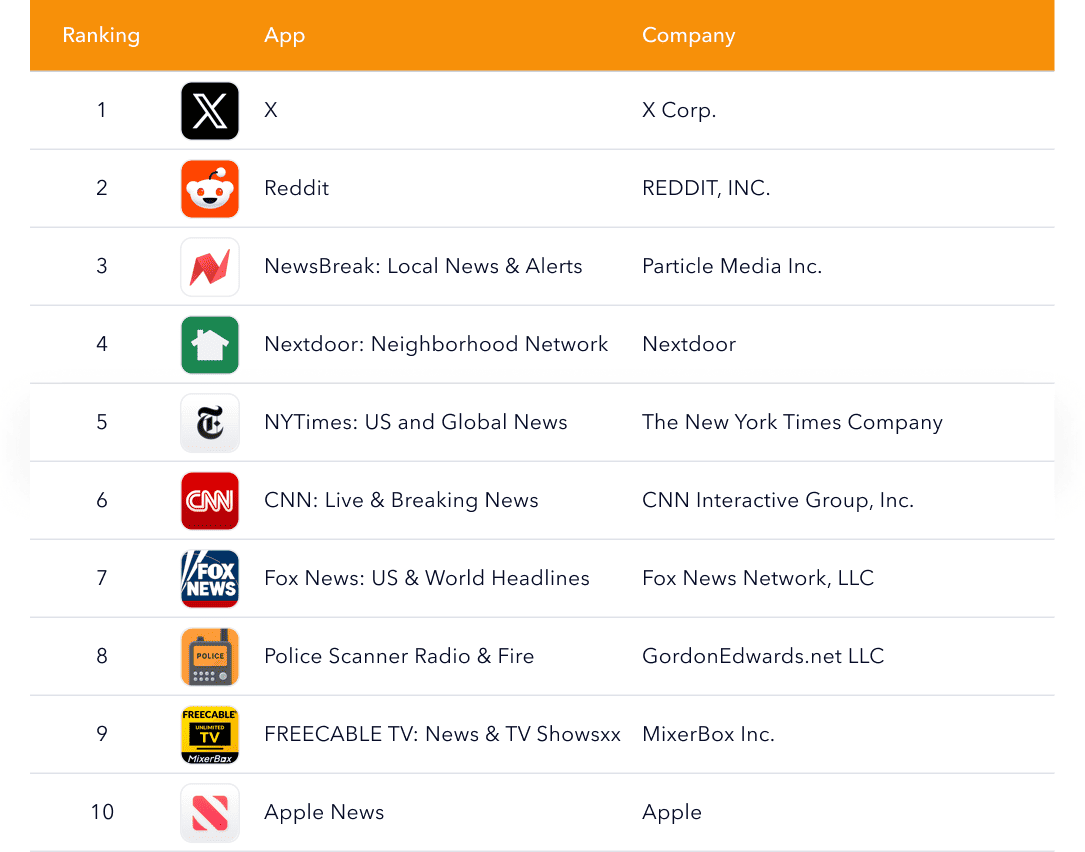
- X is a real-time feed where people track breaking stories, live events, and trending conversations as they unfold. It performs well in search because the “what’s happening now” use case never really stops, and many users don’t search generically; they search the brand when they want fast updates. Its listing leans into broad terms like “breaking news” and “live events”, which keeps it relevant for general news queries while still reflecting how people actually use it.
- Reddit is built around topic communities, where news and trends surface through posts, comment threads, and long discussions. It ranks well because it fits both “news and discussion” behavior and a huge set of niche interests, so it can show up across many different searches even when users aren’t looking for a traditional publisher.
- NewsBreak is a local-first news app that pushes updates and alerts about what’s happening nearby. It performs well because “local news” intent is direct and repeatable, and alerts are a strong conversion driver; users install when they want information delivered to them, not hunted down. It covers local breaking updates, community happenings, and notification-style news consumption.
- Nextdoor centers on hyperlocal updates, safety notes, neighborhood posts, recommendations, and nearby events, more than national news coverage. It does well in search because the “my neighborhood” intent is distinct: people want information that feels close, practical, and locally trusted.
- The NYTimes is a publisher app for breaking updates and deeper reporting, delivered through articles alongside formats like video and podcasts. It ranks strongly because it benefits from heavy brand demand and also converts on broad breaking news searches for users who want a well-known, full-coverage source.
- CNN is designed for fast, ongoing coverage, mixing articles with video, live elements, and other formats like podcasts or live audio, depending on the region. It performs well because many users search with a simple intent, breaking, live, and CNN signals, which can satisfy both reading and watching in one place. The metadata stacks broad terms like “breaking” and “live” with concrete format cues (videos, podcasts, live audio), which widens eligibility across multiple high-intent queries.
- Fox News focuses on headline-driven news, analysis, and access to live or on-demand video programming. It performs well because a large portion of demand is brand-led, and “headlines” plus “live news” wording converts for audiences who want immediate updates and a watchable format. Its listing is explicit about always-on headlines and streaming, which makes it easy to understand for users searching for live news viewing.
- Police Scanner Radio & Fire is a scanner listening app that streams police and fire radio feeds, often paired with alert-style framing for local incidents. It ranks well because “police scanner” is an exact, problem-solving search; users usually download it with a specific real-time incident curiosity, not general news browsing. Its metadata leads with “police scanner” and “breaking alerts” language, closely matching what users type when they want immediate local visibility.
- FREECABLE TV positions itself as a “cable-like” viewing app that mixes news with other TV content, leaning into live and streaming language. It performs well because it can capture both “watch news” intent and broader “free TV” browsing, which expands its reach beyond traditional news-reader apps. Their metadata repeats broad terms like “breaking news”, “live news”, and “streaming” to stay eligible across both news and TV-style searches.
- Apple News is an aggregator that curates and personalizes a feed based on what users read, with local and sports coverage depending on region and plan. It performs well because it matches a very broad “news” intent. Its metadata stays simple, news, local news, sports, then layers in clear benefit cues around curation and personalization to help users understand the experience quickly.
Utilities
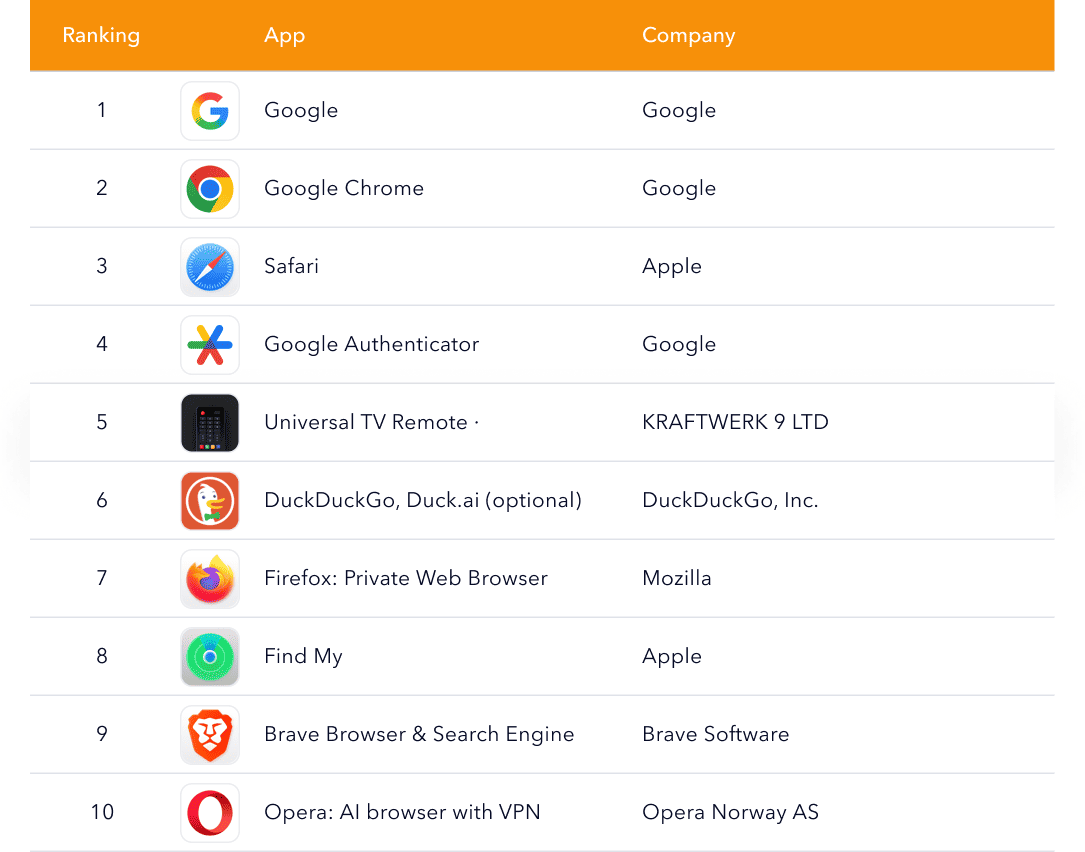
- Google is a search app designed to help users find information quickly and follow topics through features like Discover. It performs strongly in App Store search because it aligns with the broadest possible utility intent, searching for anything, while benefiting from extremely high brand demand. Its metadata stays anchored on broad, high-volume terms like “search,” “answers,” and feature-led wording tied to discovery, keeping it visible across core utility queries.
- Google Chrome is a web browser built for browsing websites, searching, and syncing activity across devices. It performs well because “browser” is a constant utility need, and Chrome converts reliably through familiarity and ecosystem trust. Its metadata emphasizes clear, high-intent terms such as “browser,” “fast,” and “secure,” alongside Google-powered actions like voice search and translation support.
- Safari is Apple’s web browser, focused on fast performance, privacy protection, and seamless syncing across devices. It performs well in search by matching the most universal intent, browsing the web, while converting users who prefer a built-in solution. Its metadata highlights concrete, familiar terms like “privacy,” “private browsing,” and “translate,” which clearly describe recognized features.
- Google Authenticator is a security app that generates one-time codes for two-step sign-ins, including offline use. It ranks well because “authenticator” is a high-intent query tied to immediate account setup needs. Its metadata is intentionally literal, built around terms like “Authenticator,” “verification codes,” and “2-Step Verification,” which improves relevance and conversion.
- Universal TV Remote turns a phone into a remote control for smart TVs. It performs well because “TV remote” is a problem-driven query, often searched in urgent moments when a physical remote is missing. Its metadata relies on direct, solution-focused terms like “remote,” “TV,” and “universal,” closely matching real user searches.
- DuckDuckGo is a private browser and search app centered on reducing tracking and keeping searches private, with optional AI-assisted features. It performs well because privacy is a major Utilities theme, and users searching for alternatives often have a clear intent. Its metadata repeatedly reinforces intent-driven language such as “privacy,” “private browser,” and no-tracking framing, making the benefit immediately clear.
- Firefox is a web browser focused on privacy controls, including tracker blocking and private windows. It performs well because it aligns with high-intent privacy searches and benefits from long-standing brand trust. Its metadata uses explicit terms like “private,” “privacy,” and “tracker,” supported by protection-focused wording that matches common search behavior.
- Find My is Apple’s app for locating devices and compatible items, with map-based tracking and location sharing. It performs strongly because it matches urgent, high-conversion queriesç. Its metadata uses direct, task-focused wording like “location,” “find devices,” and item-tracking language that aligns with how users search in time-sensitive situations.
- Brave is a privacy-focused browser designed to block ads and trackers while delivering faster browsing. It performs well because privacy browsers form a strong Utilities subcategory, and users searching for alternatives often have clear install intent. Its metadata stacks high-demand terms such as “adblock,” “privacy,” and “search engine,” keeping it visible across both browser and privacy queries.
- Opera is a web browser positioned around built-in AI assistance and VPN-backed privacy. It performs well in search by combining two high-conversion themes, privacy and AI, that are easy to understand from the title alone. Its metadata places the strongest terms up front, such as “AI browser” and “VPN,” and reinforces convenience and privacy through clear feature framing.