










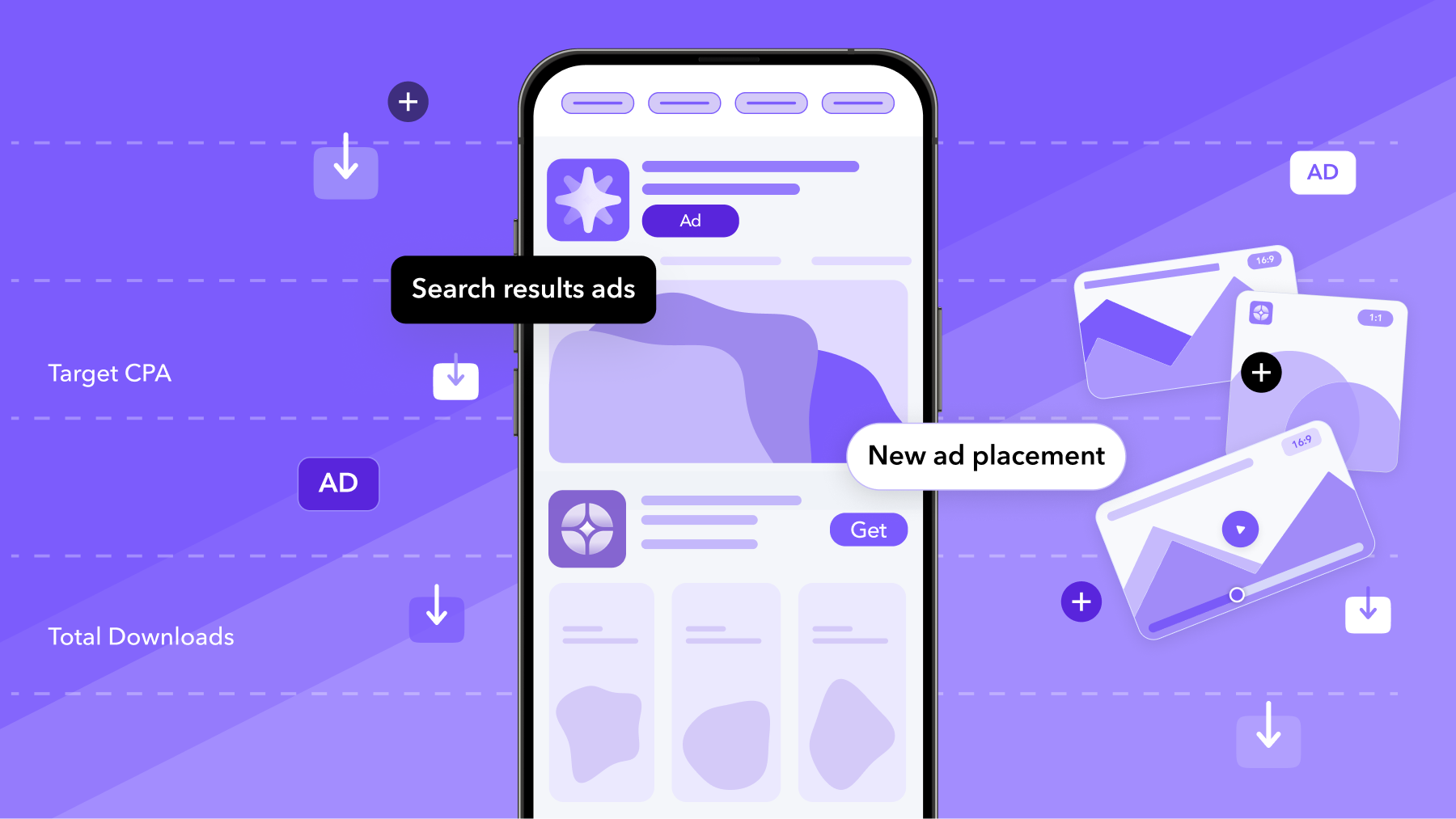
Additional ad placements in the App Store search results mark an important shift in how Apple Ads search inventory works. Starting in March 2026, search results ads will no longer appear only in the top position. They can also be shown further down the page, creating more opportunities for advertisers to appear when users are actively searching for apps.
This matters because search remains one of the strongest intent signals on the App Store. Nearly 65% of downloads happen directly after a search, and top of the search results ads have historically delivered conversion rates above 60% across Apple Ads. So, it increases advertiser presence at a moment when users are already close to making a decision.
For advertisers, the practical takeaway is simple: search results campaigns are becoming more scalable. If your strategy has been built around winning a single premium position, this change broadens the opportunity set. Coverage, relevance, creative fit, and budget pacing are about to matter even more.
What is changing

Previously, search results ads appeared only in the top position of the App Store search results. The most meaningful change is straightforward: a search results ad may now appear at the top of results or further down the page. Existing search results campaigns remain eligible for these additional positions without requiring a structural reset.
Just as important, advertisers will not be able to choose or bid for a specific position. This update is simply adding additional search ad inventory within the existing Apple Ads campaign structure.
Advertisers continue to use the same search results campaign structure. The update expands available search ad inventory, allowing eligible campaigns to appear in additional positions within search results.
That also changes how advertisers need to think about search results. Instead of focusing only on winning the top spot, the goal becomes showing up in more relevant searches and turning that added visibility into installs.
What stays the same
Even with additional placements, the fundamentals remain familiar. The ad format remains consistent across placements, and ads in search results continue to operate as part of the broader App Store advertising ecosystem alongside ads on the Search tab, Today tab ads, and product pages ads.
It’s important to understand what this change means. It strengthens search results, but the need for other placements remains. The overall structure of Apple Ads stays the same.
The underlying logic of search results also stays intact. Search results campaigns still rely on keywords to match ads with relevant queries, and relevance still determines who gets shown. More placements do not mean broader eligibility for weakly aligned ads. They mean more opportunities for well-structured campaigns to compete.
Why this matters for performance teams
The obvious upside is reach. More available positions create more chances to appear in search moments that may previously have been inaccessible, especially on competitive keywords.
But the deeper impact is operational.
Once search results campaigns include more than one placement opportunity, campaign management becomes less about securing a single visibility outcome and more about controlling performance across a wider impression pool. That can mean more impressions, more taps, and faster budget consumption. It can also introduce more performance variance if advertisers continue treating all search traffic the same way instead of structuring campaigns around distinct intent patterns.
This is exactly why search results campaigns now need to be managed with more precision. Broader opportunity without tighter control can quickly lead to noisier data, less predictable pacing, and weaker efficiency.
What advertisers should do now
The first priority is campaign structure. Brand, category, competitor, and discovery intent should be separated as clearly as possible. If campaign architecture is messy today, expanded inventory will make that problem bigger. More reach only helps when performance signals stay readable.
The second priority is product page strategy. Relying on the same product page for every audience and query becomes harder to justify when more search opportunities are available. This is the right moment to review whether default product pages are carrying too much of the load and where custom product pages can create stronger message alignment.
The third priority is budget pacing. More eligible inventory means more potential spend opportunity. Teams should monitor pacing more closely, especially on high-volume and high-competition terms, and make sure added visibility is driving incremental installs rather than just increasing tap volume.
The fourth priority is measurement. Position-based thinking becomes less useful in a world where advertisers cannot target a specific slot. The success of the campaigns should be evaluated through aggregated impressions, tap-through rate, and conversion efficiency, not through assumptions tied to one position.
Finally, teams should prepare stakeholders for a more fluid search environment. The winning approach is likely to move away from forcing visibility on a narrow group of expensive terms and toward building broader, more relevant, and better-structured search coverage that can adapt over time.
For teams using MobileAction, this measurement layer is available directly in MobileAction CMP. Total Impression Share can be analyzed alongside 1st Placement Impression Share and 2nd Placement Impression Share, helping teams understand how search results visibility is distributed at the app, keyword, and competitor level.
How to measure expanded search results visibility with MobileAction
As search results inventory expands, advertisers need a more precise way to understand visibility. Looking only at an aggregate impression share number can make it harder to see how an app is actually appearing across search results, especially when more than one ad placement can now be available for the same keyword.
That is why placement-level visibility analysis becomes more important. A keyword may look strong at the total level, but that total number does not always explain where the visibility is coming from. An app may be capturing stronger visibility in the first placement, gaining incremental visibility from the second placement, or facing heavier competitor pressure in one placement than the other.
MobileAction’s Apple Ads Intelligence now helps teams analyze this with a placement-level Impression Share breakdown for search results. Across Search Result/App, Search Result/Keyword, and Search Result/Competitor pages, advertisers can now view Total Impression Share, 1st Placement Impression Share, and 2nd Placement Impression Share separately.

MobileAction’s Search Result/Keyword view helps teams compare Total Impression Share, 1st Placement Share, and 2nd Placement Share for each keyword.
Total Impression Share shows the app’s aggregate share of impressions across available search results placements. 1st Placement Impression Share shows how much visibility the app captures in the first search results placement. 2nd Placement Impression Share shows how much visibility the app captures in the additional search results placement.
This breakdown gives teams a clearer way to evaluate keyword coverage and competitive visibility after the search results inventory expansion. For example, if a competitor has a high Total Impression Share on an important keyword, the placement-level view can help show whether that competitor is mostly winning the first placement, gaining reach through the second placement, or maintaining visibility across both.

MobileAction’s Search Result/Competitor view shows how placement-level visibility differs across unique, mutual, and competitor-paid keywords.
The same logic applies when evaluating your own app’s visibility: a keyword may be worth monitoring differently depending on whether your visibility is concentrated in the first placement or supported by the second placement as well.
This can also make keyword and competitor analysis more actionable. Instead of only asking “Are we visible on this keyword?”, teams can ask better follow-up questions: Are we visible in the most competitive placement? Are competitors gaining incremental visibility from the second placement? Is our Total Impression Share improving because of broader placement coverage? Are some high-volume keywords becoming more competitive after the inventory expansion?
Important: Total Impression Share is not the sum of 1st Placement Impression Share and 2nd Placement Impression Share. It is calculated as aggregate app impressions divided by total impressions across search results placements.
MobileAction also supports flexible date range selection for this analysis. Teams can select a range from one day up to 14 days, with the latest available data from yesterday. For dates from May 1 onward, impression share includes 2nd placement impressions. For earlier dates, the legacy calculation applies, where 2nd placement impressions are not included.
Final thoughts
Apple Ads has gradually expanded from a single search-led surface into a broader App Store advertising ecosystem. This update does something especially important because it deepens the placement where intent is clearest.
That is why the change matters so much.
As search inventory expands, results increasingly reflect segmentation accuracy, creative relevance, budget control, and measurement rigor rather than bid pressure alone. The teams that recognize this as a structural shift in search inventory, not a minor placement update, will be better positioned to benefit.
Additional ad placements in search results create more opportunities, but not automatically better outcomes. More inventory can improve reach and scale, yet performance will still depend on campaign quality. Relevance still matters. Structure still matters. Product page strategy still matters. And as search results become more dynamic, operational discipline matters even more.
The encouraging part is that advertisers do not need to rebuild everything from scratch. The foundation remains the same. What changes now is the size of the opportunity and the level of precision required to capture it effectively.
The advertisers that prepare early, clean up campaign structure, strengthen message match, and tighten measurement will be in a much stronger position to turn this change into real growth.
As search results inventory expands, a stronger message match becomes more important alongside a cleaner campaign structure and tighter measurement.
MobileAction’s Apple Ads campaign management platform supports your workflow through keyword and competitor analysis, campaign optimization, and CPP A/B testing for teams that want to improve alignment between search intent and post-tap product page experience. So, schedule a demo today to learn how our experts can help your team adapt!
Frequently asked questions
How can advertisers measure visibility across the new search results placements?
Advertisers should look beyond aggregate impression share and review how visibility is distributed across placements. In MobileAction’s Apple Ads Intelligence, teams can now see Total Impression Share alongside 1st Placement Impression Share and 2nd Placement Impression Share on Search Result/App, Search Result/Keyword, and Search Result/Competitor pages. This helps show whether an app’s visibility is coming mainly from the top position, the additional search results placement, or both.
Can advertisers choose which search results position their ad appears in?
No. Advertisers cannot target or bid for a specific search results position.
Do existing search results campaigns need to be changed?
No. These additional placements are part of the existing search results campaign setup, not a separate campaign type. That means advertisers already running search results campaigns can participate without rebuilding their account structure from scratch.
Does the ad format change in the new positions?
The format remains the same across search results placements. What changes is where the ad can appear within search results, not the structure of the ad itself.
Do bids alone decide whether an ad shows?
Bid strength still matters, but it is not the only factor that shapes visibility. Relevance remains essential in determining whether an ad can appear for a given search. That is why stronger keyword alignment, better campaign structure, and a more relevant post-tap experience remain critical as search results inventory expands.

Content Marketing Manager
Resources that you'll love



Grow your app on the App Store and Google Play Store with our solutions now