








Looking to boost your app's visibility and acquire more users? Our 2025 ASO Report is your ultimate guide to navigating the evolving app store landscape. Packed with data-driven insights, keyword trends, and top-ranking app strategies, this report will equip you with the knowledge to optimize your app's presence and achieve organic growth.
If you’re trying to sell an app idea, the first thing you should know is this: ideas rarely get bought on their own.
In 2026, companies pay for things that reduce uncertainty. That can be user traction, a working MVP, clear demand signals, or a feature that fits directly into an existing product. An idea without proof is usually seen as a starting point, not an asset.
In this blog, we look at how to sell an app idea in practice. We focus on what changes as you move from idea to prototype to MVP, what buyers expect at each stage, and how you can make an idea more credible before you start pitching. If you’re trying to decide what to build, who to approach, or whether your app idea is sellable at all, understanding these dynamics early makes the difference.
Can you sell an app idea?
Yes, but not in the way most people expect.
In most cases, you cannot sell a standalone app idea for meaningful money, especially to large tech companies. What buyers actually pay for is execution, proof, or strategic value, not raw app ideas.
Idea vs MVP vs live app (why this difference matters)
- Idea only: Lowest value. Usually not sellable on its own unless paired with rare IP or deep domain expertise.
- MVP or prototype: Moderate value. Can be sold if it demonstrates a clear problem-solution fit.
- Live app with users or revenue: Highest value. This is what most buyers actively look for.
The more proof you attach to the idea, the more leverage you gain in any negotiation.
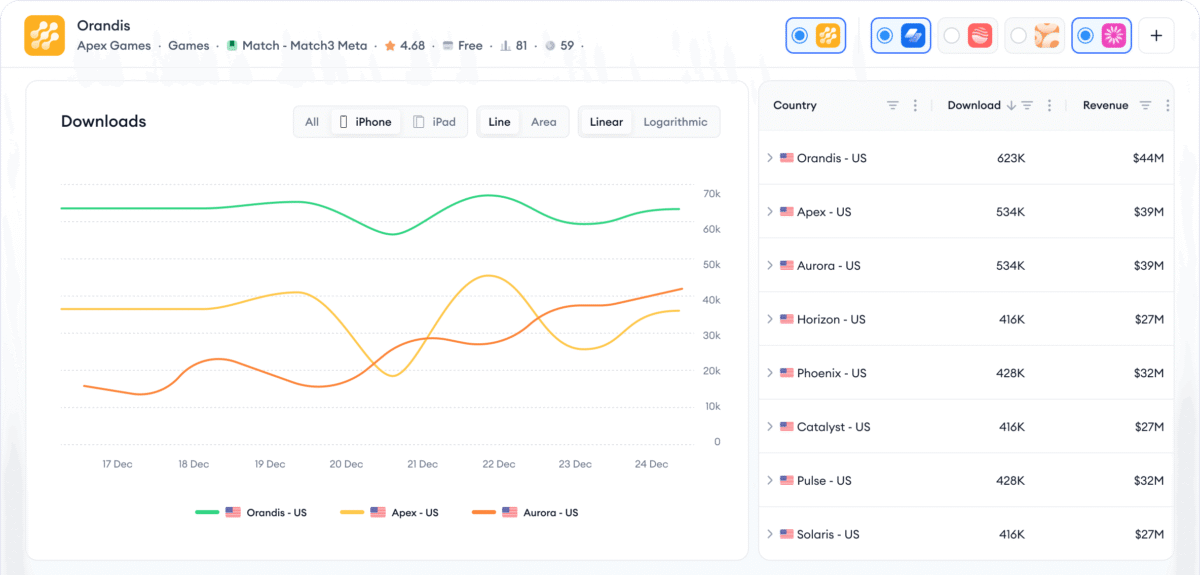
But proof doesn’t mean “a few people liked it.” Buyers want clear answers to questions like: Do apps in this category actually make money? Who already dominates it? How competitive is the market, and where are the gaps?
To answer these, you need to know app download estimates and competitor signals. With MobileAction, Market Intelligence shows estimated download and revenue trends by category and country, helping you validate whether demand is actually increasing.
Can you sell an app idea to big tech (Apple, Google, etc.)?
Apple, Google, and Meta do not buy unsolicited app ideas. They acquire working products, teams, or strategic assets that already show momentum or competitive advantage.
If you want to sell something to big tech, the path almost always looks like this:
idea → MVP → traction → strategic relevance → acquisition
Understanding this early saves time and prevents unrealistic expectations.
I have an idea for an app. Where do I start? (idea vs MVP vs live app)
Before you think about selling anything, it helps to pause and be honest with yourself. Where you are right now matters more than how good your idea sounds. Each stage opens up different paths, and trying to skip steps usually backfires.
| Your current stage | What you can realistically do | What this stage is about |
| Just an idea | • License a specific feature • Find a co-founder or strategic partner • Build a very lean MVP |
Making the idea concrete enough for someone else to evaluate |
| Prototype or MVP | • Partner with a development studio or agency • Pitch to early-stage companies • Test demand and refine scope |
Reducing risk by proving the idea can work in practice |
| Users or revenue | • Sell the app as a digital asset • Approach strategic buyers • Start acquisition or team-acquisition conversations |
Turning traction into a business opportunity |
7 ways to sell an app idea (or make it sellable)
Selling an app idea rarely means handing over a one-line concept and getting paid for it. In reality, it means finding the right format in which your idea becomes valuable to someone else.
The methods we add are the paths that actually work in the real world, depending on your stage, credibility, and goals.
1. License the idea or a specific feature
Who buys: SaaS companies, enterprise teams
Licensing is one of the few ways to monetize an app idea without building a full product. Instead of selling the entire idea, you license a specific feature, workflow, or concept to a company that already has users, distribution, and engineering resources. The company implements the feature themselves and pays you through a licensing fee or a revenue share.
This approach works best when certain conditions are met. In practice, licensing is most effective when:
- the idea improves an existing product rather than creating a new one,
- the feature clearly solves a problem for a defined user group, and
- the buyer can implement it faster than you could build and scale a full app on your own.
In this model, you’re not pitching a startup or a long-term vision. You’re proposing a concrete improvement that fits into someone else’s roadmap.
To justify that fit, you need to show how the feature compares to what already exists in the buyer’s category. That means looking at competing apps and running a quick mobile app competitor analysis to understand how they position themselves in the store, and which problems they emphasize or ignore.
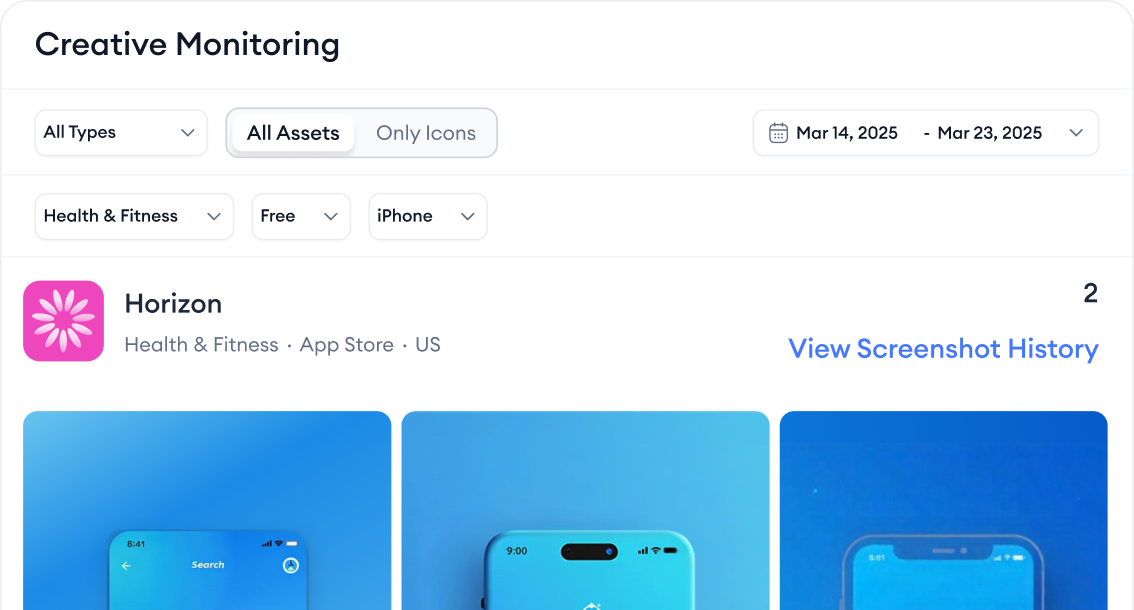
Using MobileAction, Competitor Keywords helps you see which problems competitors actively target through their metadata, while Creative Monitoring shows how they communicate value through app screenshots and icons, from layout and messaging to compliance with current App Store screenshot guidelines and effective app icon design standards.
2. Partner with a development studio (rev-share or build-to-sell)
Who buys: Agencies, studios, product builders
If you have a solid app idea but don’t have the technical team to build it, a development studio can be a realistic path forward.
You’re not selling the idea outright. You’re bringing it to a studio that already has the engineers, designers, and delivery process to ship. In return, they typically ask for equity, a revenue share, or a shared “build-to-sell” plan, because they’re investing time and execution, not just taking a brief.
Studios look for ideas with clear demand signals because it reduces their biggest risk: building something no one ends up using. And for you, it removes the biggest bottleneck: getting from concept to a real, testable product.
3. Find a co-founder or strategic partner
Who buys: Not buyers, partners
When you don’t have the technical skills, network, or resources to turn an idea into a product on your own, finding a co-founder or strategic partner can be the fastest and most realistic path forward.
Unlike working with a development studio, this is not execution outsourcing. You’re not hiring a team to build something for you. You’re sharing ownership of the outcome. Instead of trying to sell an app idea for cash, you exchange part of the upside for long-term commitment, execution, and credibility.
In this model, you’re not selling an app idea in the traditional sense. You’re selling belief: why the problem matters, why now is the right moment, and why this opportunity is worth building together over time. The value isn’t just the idea itself, but the vision and conviction behind it.
Strategic partners can take different forms. It might be a technical co-founder who wants to own and grow the product with you. It could be a small company interested in co-developing something that aligns with its roadmap. In some cases, it’s a team or individual who sees the idea as a way to enter a new market faster, with shared risk and shared upside.
The key distinction is intent.
A studio helps you build.
A co-founder helps you build and own.
That difference changes everything: decision-making, incentives, and how far the idea can realistically go.
4. Build a fast MVP and sell the product
Who buys: Startups, SMBs, niche players
If you want to sell an app idea, the most effective way to do it is to stop selling the idea and start selling a working product.
A fast MVP turns an abstract concept into something buyers can evaluate. It makes the opportunity tangible and lowers the risk for potential buyers.
This approach works best when:
- The idea is hard to validate without seeing it
- Speed matters more than polish
- You want flexibility: sell, partner, or keep building
A “fast MVP” means building only what proves the core value, one use case, one primary user flow, and nothing more.
Once the MVP is live, focus on feedback that improves perceived quality. Addressing common friction points strengthens how the product is evaluated, and guidance on how to improve app store ratings can support this step.
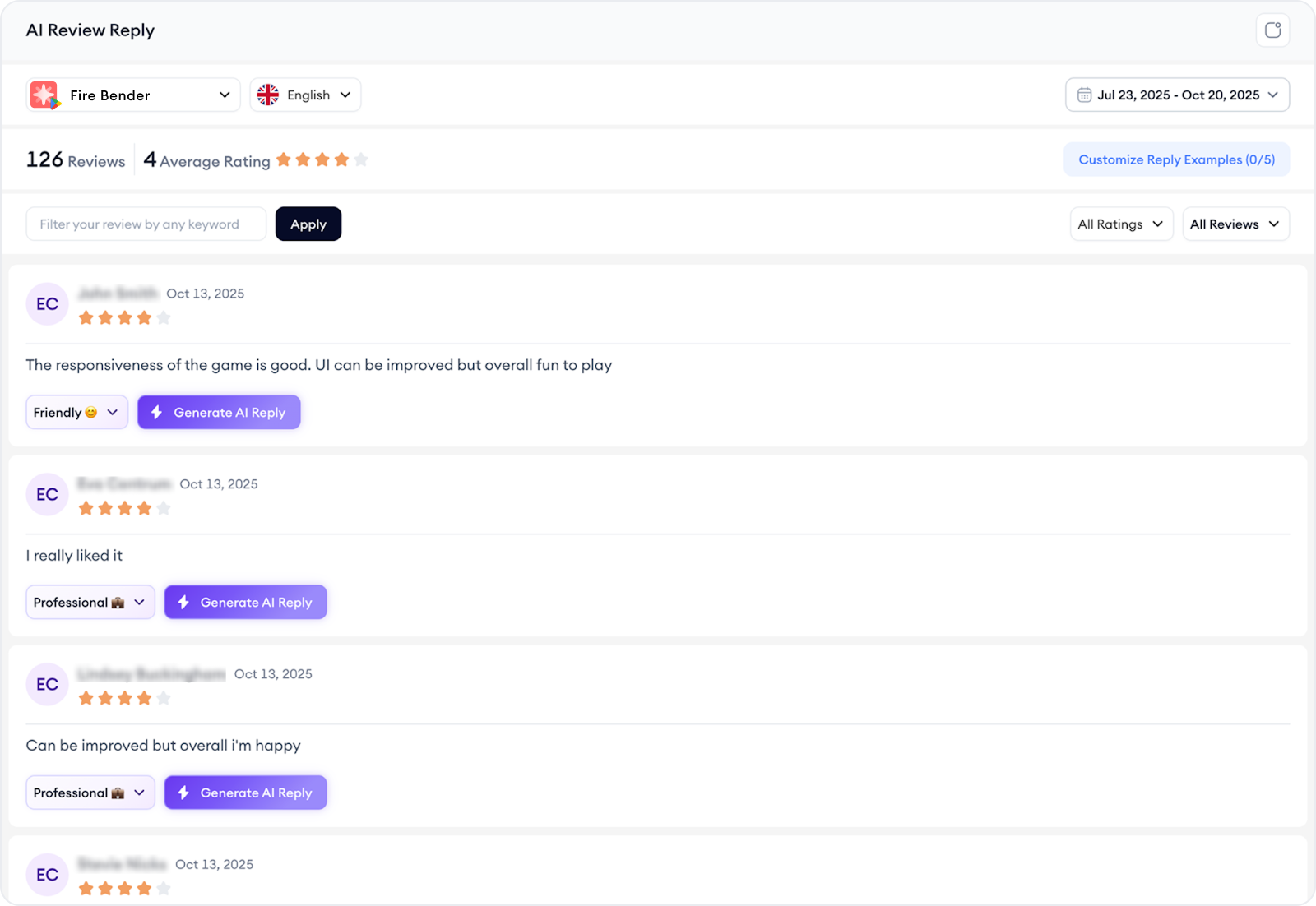
Separately, use competitor reviews to refine scope. Recurring complaints reveal where demand already exists and where competitors fall short. MobileAction’s Reviews tab help surface these gaps quickly.
At this point, you’re no longer pitching an idea; you’re showing a product. That alone changes how buyers engage. Early mobile user acquisitions often happen here because an MVP is faster and cheaper to acquire than to build from scratch.
5. Sell the app as a digital asset
Who buys: Indie founders, roll-ups
Once your app has users, revenue, or consistent activity, it can be sold as a digital asset, even if it’s small.
At this stage, you’re no longer trying to convince someone that the idea is good. The market has already done that for you. What buyers care about now is performance: how the app monetizes, how stable it is, and how much effort it takes to maintain or grow.
Selling an app as a digital asset is common when:
- The app has steady users or predictable revenue
- Growth may be modest, but reliable
- The product can run with minimal ongoing involvement
Buyers in this space are often founders, small companies, or operators looking to acquire existing products rather than start from zero. For them, buying an app can be faster and less risky than building one internally.
In these conversations, the app itself, not the original idea, is the value. Metrics like revenue trends, mobile app retention, acquisition channels, and operational costs matter far more than vision or long-term storytelling.
6. Strategic buyer outreach (competitors and adjacent products)
Who buys: Companies solving similar problems
Strategic buyers don’t buy app ideas for what they are today. They buy them for what they can become inside their existing business.
This approach makes sense when your app, feature, or product clearly complements something another company already does. Instead of competing, you help them move faster, enter a new market, or strengthen an existing position.
Strategic buyers are often:
- Companies in the same or adjacent category
- Businesses serving the same audience with a different product
- Teams looking to accelerate a roadmap rather than build from scratch
At this stage, selling an app idea means selling context and fit. You’re not just showing what you built; you’re explaining why it matters specifically to them. Strong alignment makes the conversation feel less like a pitch and more like a shortcut.
This approach works best when:
- Your idea solves a problem the buyer already recognizes
- The integration path is clear
- The acquisition saves time, cost, or risk
Strategic outreach isn’t about blasting cold emails. It’s about targeted conversations with the right companies, grounded in a clear understanding of their product, users, and goals.
When done well, these deals can move quickly. For buyers, acquiring a focused app or feature is often faster and cheaper than building internally. For you, it turns relevance into real value, without needing massive scale.
7. IP route: patent or trademark (when it makes sense)
Who buys: Corporations, R&D teams
For some app ideas, the value isn’t in users or revenue, it’s in the intellectual property behind the idea.
This route only makes sense in specific situations. Most app ideas are not patentable, and filing IP protection too early can be expensive, slow, and unnecessary. But when an idea involves a novel technical solution, a unique algorithm, or a defensible process, IP can become a real asset.
The IP or patent route works best when:
- The idea includes a genuinely novel technical approach
- The solution is difficult to replicate without access to the underlying method
- The buyer operates in an industry where IP protection matters (enterprise, healthcare, fintech, deep tech)
In these cases, you’re not selling an app or even a product. You’re selling exclusive rights, the ability to use, license, or build on top of a protected concept.
Buyers here tend to be larger companies, R&D-focused teams, or organizations with long product cycles. What they care about is not speed to market, but defensibility and long-term advantage.
That said, this path comes with trade-offs. Patents take time, require legal expertise, and don’t guarantee commercial success. An idea can be protected and still have no market. That’s why IP should support a real business case, not replace it.
How much is an app idea worth? (simple valuation signals)
An app idea, on its own, is usually worth far less than people expect. Not because ideas aren’t valuable, but because value in this context is tied to risk reduction, not creativity. The less uncertainty a buyer has to take on, the more they’re willing to pay.
So instead of asking “How much is my idea worth?”, buyers are really asking: “How much risk am I taking on if I buy this?”
Why app ideas are hard to price
When you only have an idea, there are too many unknowns:
- Will anyone actually want this?
- Can it be built efficiently?
- Will it scale?
- Does it fit the buyer’s product or market?
Because of that uncertainty, raw ideas are rarely valued as standalone assets. In most cases, they’re treated as inputs to a larger process, not finished products.
This is why learning how to sell an idea for an app almost always involves increasing its value before trying to price it.
What increases the value of an app idea
As your idea moves through stages, valuation becomes more realistic and more defensible. Here are the signals buyers typically care about:
- Clarity of problem and solution. A well-defined problem with a clear, focused solution is easier to value than a broad or vague concept.
- Execution proof. An MVP, prototype, or working demo dramatically increases perceived value by showing feasibility.
- Market validation. User feedback, pilots, waitlists, or early usage data reduce demand risk.
- Traction metrics. Users, engagement, revenue, or growth trends turn an idea into a business asset.
- Strategic fit. An idea that clearly supports a buyer’s existing product or roadmap is often worth more to them than to anyone else.
How to pitch an app idea to a company (templates included)
Once you understand how to sell an app idea, the next challenge is knowing how to pitch an app idea in a way that actually gets a response.
Most app idea pitches fail not because the idea is weak, but because the pitch is unfocused. Companies don’t want long stories, future fantasies, or generic enthusiasm. They want clarity, relevance, and a reason to keep listening.
1. Start with their problem, not your idea
When pitching app ideas, it’s tempting to lead with what you’ve built or what you plan to build. In reality, the strongest pitches start somewhere else: the buyer’s problem.
A good opening makes it immediately clear that:
- You understand their product or market
- You’ve identified a gap or opportunity they already care about
- Your idea helps them move faster or reduce risk
This is especially important when you’re figuring out how to sell an app idea to a company. The pitch should feel tailored, not reusable.
Keep the pitch short and concrete
Whether you’re sending an email, a LinkedIn message, or giving a short presentation, your pitch should answer three questions quickly:
- What problem does this solve?
- Who is it for?
- Why does it matter to this company?
Avoid long explanations or detailed roadmaps at the start. Your goal is not to explain everything, it’s to earn the next conversation.
A simple pitch structure that works
When people ask “How do I pitch an app idea?”, this is a reliable structure to follow:
- Context: One sentence on the problem or gap you’ve identified
- Solution: One sentence on what your app or feature does
- Fit: One sentence on why it makes sense for them
- Next step: A low-friction call to continue the conversation
This works whether you’re pitching a raw idea, an MVP, or a live app.
What to include, and what to avoid
Include:
- A clear use case
- Any proof you have (even small signals)
- A realistic next step
Avoid:
- Overpromising outcomes or revenue
- Explaining the entire product upfront
- Generic language that could apply to any company
Remember, pitching app ideas is not about persuasion. It’s about alignment.
Early in the process, too much detail can actually slow things down. Buyers don’t need to see everything, they need to see enough to understand the value and decide whether to go deeper.
If they’re interested, they’ll ask for more.
How to protect your app idea (NDA and ownership basics)
Once conversations start moving forward, a new concern usually comes up: how do I protect my app idea?
This is especially common when you’re early and still figuring out how to sell an idea for an app without losing control of it.
The good news is that protection doesn’t have to be complicated. The bad news is that many people focus on the wrong things.
What an NDA actually does, and what it doesn’t
A non-disclosure agreement (NDA) can be useful, but it’s often misunderstood.
An NDA helps when:
- You’re sharing non-public details
- There’s a clear business context
- Both sides already have some level of interest
An NDA does not protect:
- A broad or generic idea
- Something that’s already obvious in the market
- An idea shared without clear documentation
In early conversations, many companies won’t sign an NDA right away. That’s normal, and not necessarily a red flag. What matters more is how and how much you share.
Share enough to evaluate
When learning how to sell an app idea, one of the most important skills is knowing what to hold back.
Early on, you should focus on the problem you’re solving, the outcome your solution enables and why it’s valuable to the buyer.
You don’t need to disclose full technical implementations, proprietary algorithms, and detailed workflows that enable easy copying.
If a buyer wants to go deeper, that’s usually the right moment to introduce formal protections.
Ownership clarity matters more than paperwork
Deals fall apart more often because of unclear ownership than because of stolen ideas.
Before pitching app ideas seriously, make sure you can clearly answer: Who owns the idea and any code? Are there co-founders or contributors? Are there third-party assets or licenses involved?
Clear answers build trust, and trust speeds up deals.
Think practically
Most companies don’t want to steal your idea. They want to avoid risk. Approaching conversations with excessive fear or legal pressure can slow things down and signal inexperience.
Protect your work, but stay focused on progress. In most cases, execution, timing, and relationships matter far more than secrecy.
Frequently asked questions
How can you sell an app idea to Apple in 2026?
In practical terms, you can’t sell a raw app idea to Apple. Apple has a clear and explicit policy against accepting or reviewing unsolicited ideas, and that policy exists to avoid legal and strategic risk. Because of this, there is no channel where you can pitch an idea and wait for feedback or an offer.
What is possible is selling an actual iOS app to another developer. Apple supports this through App Store Connect’s app transfer process, which allows ownership of an app, along with its listing, users, and ratings, to move from one developer account to another. In this scenario, Apple is not the buyer; it is simply the platform facilitating the transfer.
If your longer-term goal is an Apple acquisition, the only viable path is indirect. Apple acquires products, teams, or technology that already matter. That means building an app far enough that it shows real usage, defensible technology, or strategic relevance. Only at that point do conversations happen, usually through warm introductions rather than formal submissions. The key shift is understanding that Apple doesn’t buy ideas, it buys reduced risk.
How can you sell an app idea to Google in 2026?
Google operates under a similar philosophy. There is no official way to submit an app idea and receive payment or evaluation. Even Google’s own developer communities tend to be very direct about this: ideas alone are not assets. If you approach Google too early, the most likely response is guidance toward employment or encouragement to build the product independently.
Where Google does provide structure is once a product exists. If you have a live Android app, it can be sold to another buyer and transferred through Google Play Console, including its store presence and user base. This is a legitimate and common route in smaller acquisitions, but again, Google itself is not the buyer.
For founders who hope for a Google acquisition, the realistic approach is to build within Google’s ecosystem until the product stands on its own. Startup accelerators and cloud programs exist to support growth and visibility, not to purchase ideas. Only after usage, retention, or strategic fit is clearly demonstrated do acquisition conversations become possible.
How can you sell an app idea to Facebook (Meta) in 2026?
Meta’s ecosystem can be misleading at first glance. The company actively encourages developers to build on its platforms and provides extensive APIs, tools, and partnership programs. However, these are designed to help products grow on Meta’s infrastructure, not to evaluate or purchase raw ideas.
Meta does accept product feedback and feature requests for its existing products, but this is often misunderstood. Submitting feedback does not mean pitching an app idea for acquisition; it simply helps Meta improve its own platforms.
As with Apple and Google, Meta acquisitions happen around execution. A product with strong engagement, a feature that clearly enhances Meta’s platforms, or technology aligned with Meta’s long-term priorities can become interesting. But that interest only comes once the product exists and shows real-world value. There is no public funnel for selling an idea directly.
Conclusion: how to sell an app idea in 2026
Selling an app idea isn’t about convincing someone that your idea is smart. It’s about showing that it’s credible. In 2026, ideas become sellable only when they’re supported by proof, clear demand, a working MVP, early traction, or strong strategic fit.
The paths we covered all lead to the same conclusion: execution reduces risk. The more signals you can show, the easier it is to move from pitching app ideas to having real conversations with buyers or partners.
Before you pitch, be clear on your stage and build just enough validation to make the opportunity tangible. That’s what turns an idea into something worth buying.
If you want to understand whether your app idea is actually viable, how competitive the category is, where demand exists, and what gaps you can target, MobileAction can help.
Sign up for MobileAction to explore market trends, competitor insights, and demand signals before you build or sell.

Your mobile app growth partner with intelligence, automation and expertise.
Resources that you'll love

![App Store Optimization made simple – The complete ASO checklist in 2026 [UPDATED]](https://mobileaction.co/cdn-cgi/image//https://www.mobileaction.co/wp-content/uploads/complete-aso-checklist-.jpg)
Grow your app on the App Store and Google Play Store with our solutions now