










Looking to boost your app's visibility and acquire more users? Our 2025 ASO Report is your ultimate guide to navigating the evolving app store landscape. Packed with data-driven insights, keyword trends, and top-ranking app strategies, this report will equip you with the knowledge to optimize your app's presence and achieve organic growth.
App Store Optimization is a must-have strategy for any app publisher aiming to boost organic downloads. With millions of apps vying for visibility, relying on generic advice or one-time tweaks is no longer enough. You might have already covered the basics, crafting a keyword-rich title, writing a concise subtitle, and adding eye-catching screenshots, yet still find your app struggling to rank well or attract steady organic installs.
If that sounds familiar, don’t worry. What you need are data-driven ASO tips and tricks that go beyond the basics, helping you continuously improve your app’s visibility and conversion. In this comprehensive blog, we’ll share free ASO tips and advanced tactics to elevate your app store rankings in 2025 and beyond.

1. Know your competitors
One of the most powerful app store optimization ASO tips is to start by deeply understanding your competitive landscape. Many app marketers focus only on their own metadata and forget that your competitors are your roadmap. If a rival app consistently outranks you, analyzing their strategy can reveal exactly why. Competitor intelligence is the foundation of a winning ASO plan; it shows you what’s working in your niche and where the opportunities lie.
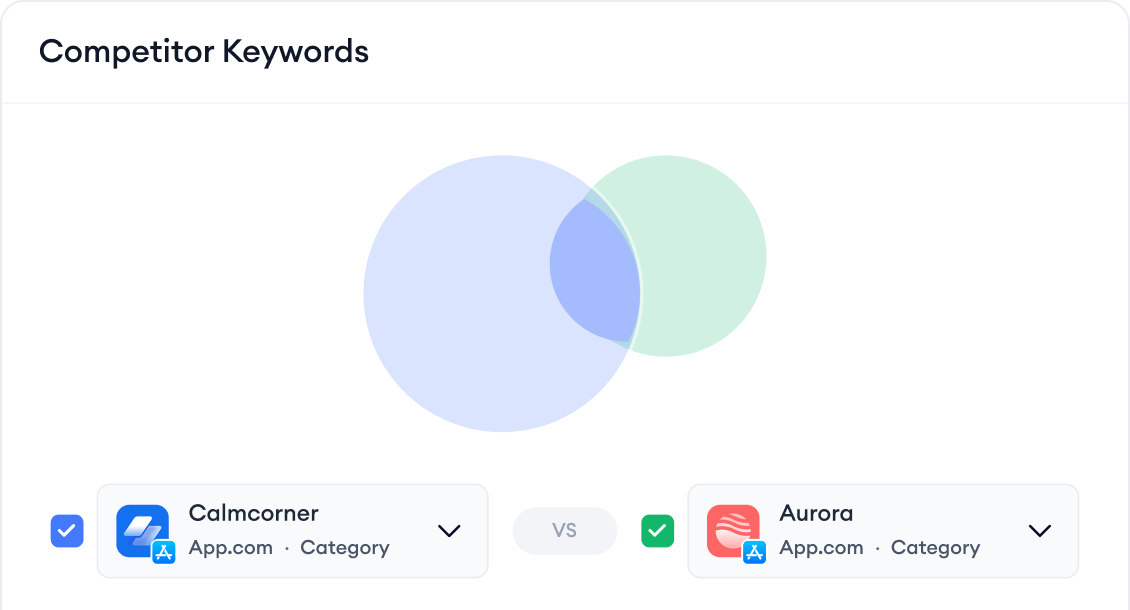
Start with a competitor keywords gap analysis. Instead of guessing which keywords to target, let your competitors guide you. MobileAction’s Competitor Keywords feature allows you to instantly see which search terms competing apps rank for that you haven’t covered. This gap analysis is an invaluable ASO trick: it uncovers high-value keywords you might have missed and avoids ones dominated by others.
2. Leverage data-driven keyword research
Keyword research remain the cornerstone of ASO, but the way to master them in 2025 is through data, not intuition. It’s time to move beyond simple brainstorming and embrace a more structured approach to keyword optimization.
Remember, not all keywords are created equal. Some have high search volume but also high competition; others are niche but easier to rank for. A data-driven keyword research helps evaluate each keyword’s potential. It provides metrics such as search volume, difficulty score, and relevance all in one view. By reviewing the numbers, you can prioritize keywords that offer the best visibility gain for your effort.
User search behavior isn’t static; new search terms emerge as trends and seasons change. Regularly reviewing keyword trend data ensures your metadata stays fresh and aligned with what users are currently searching.
3. Optimize your metadata with a strategic mindset
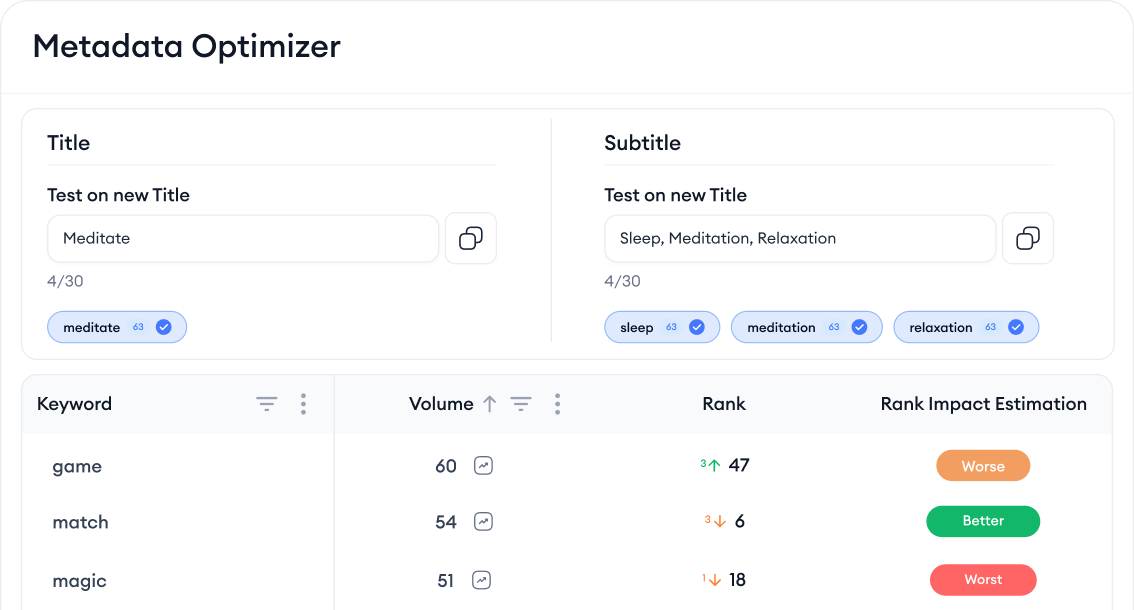
Once you’ve identified the right keywords, the next ASO tip is to implement them optimally in your app’s metadata (title, subtitle, description, and keyword field on iOS). This might sound like ASO 101, but there are some tips and tricks that even experienced app marketers overlook when updating metadata:
-
Prioritize Title & Subtitle (or Short Description)
Title and subtitle carry the heaviest weight for ASO. Your app title must include your most important keyword whenever possible, ideally right at the beginning for maximum impact. Think of the subtitle as a tagline that conveys your app’s main benefit while sneaking in one or two secondary keywords. Avoid keyword stuffing as both stores penalize obvious repetition or unnatural lists of terms.
#Pro tip: Use MobileAction’s Keyword Density Checker to optimize your app description.
- Utilize the Keyword Field (iOS specific)
App Store gives you a 100-character “Keywords” field not visible to users, purely for ASO. This is prime real estate to include variations, long-tails, and misspellings you couldn’t fit in the visible text. Use commas to separate terms, and don’t repeat words you already have in your title or subtitle, you’re just wasting space if you do. This behind-the-scenes optimization is a quick trick to broaden the net of search queries that can trigger your app.
-
Write an engaging, keyword-informed description:
On Google Play, the long description actually influences ASO (unlike on iOS, where it’s mostly for persuasion). For Play Store apps, ensure your description naturally includes important keywords multiple times, especially in the first few lines, since Google Play Store does index it. Regardless of platform, make your description persuasive: highlight unique features, use short paragraphs or bullet points for readability, and include a call-to-action. A pro tip is to localize your description so that users in each market see content in their language with relevant keywords for them. Remember, an informative, well-written description can improve conversion rates by convincing users to download after they find you via search.
-
Keep an eye on character limits and keyword density
Each field has limits (e.g., 30 characters for Apple and Google app title, 80 for Google short description, 4,000 for long description, etc.). Use every available character wisely, especially in the title and subtitle. At the same time, maintain a reasonable keyword density, stuffing a keyword 10 times in the description won’t help and may hurt. A good rule of thumb is to include a keyword about 3-5 times in a long description, and ensure it reads organically. Tools can help analyze your metadata’s keyword usage; for example, MobileAction’s Metadata Optimizer can suggest improvements and flag if you’re under-using or over-using certain terms.
-
Test and iterate your metadata
Don’t set your keywords and forget them. A clever ASO tip and tricks approach is to treat metadata as living content. When you push app updates (new versions), take the opportunity to tweak your title or subtitle if you’ve identified a better keyword or a more compelling phrasing.
4. Create irresistible visuals to improve conversion
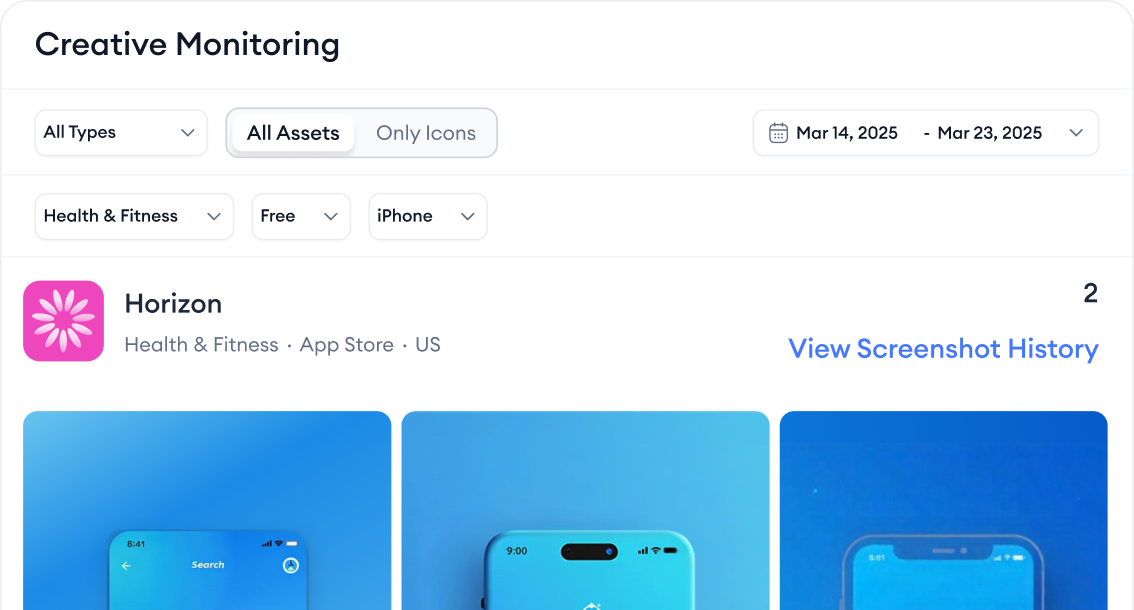
Getting users to find your app is half the battle; the other half is convincing them to download it. That’s where creative optimization, your app icon, screenshots, and preview video come into play. Improving conversion (the percentage of store visitors who install) directly influences rankings too: more installs, especially in a short period, can boost your app’s position in search results. Below are key ASO tips and tricks to optimize your visuals and stand out from the crowd:
-
Design a distinctive, clear app icon
Your icon is often the first visual element users see in search results or top charts. It should instantly convey what your app does or the vibe it offers, without being cluttered. Simplicity and recognizability are key. Use bold colors (that contrast with typical backgrounds), minimal text (if any), and imagery that reflects your app’s core purpose. One trick is to analyze the color schemes of your competitors’ icons using a tool like Creative Monitoring. If all rival finance apps are using blue icons, a bright orange icon might help yours pop on the screen.
-
Optimize screenshots for messaging and impact
Screenshots should do more than just show in-app screens; they should tell a story of your app’s best features. Use the first 2–3 screenshots to highlight your unique value propositions with short, punchy captions. Ensure the text is large and readable on small screens. You can use all available screenshot slots (usually 8-10 images) but know that many users won’t swipe through them all unless the first few really grab attention. Each screenshot should showcase something different and important.
-
Include an app preview video if possible
Videos can dramatically increase conversion by demonstrating real app usage and excitement. Both App Store and Google Play allow you to add preview videos. Keep the video short (15-30 seconds is ideal) and engaging from the first second, users often decide within moments if they’ll keep watching. Highlight the core experience: show the app in action, animations of features, or even user testimonials, depending on the app type. Use captions or graphics in the video to reinforce key points.
5. Expand your reach with localization
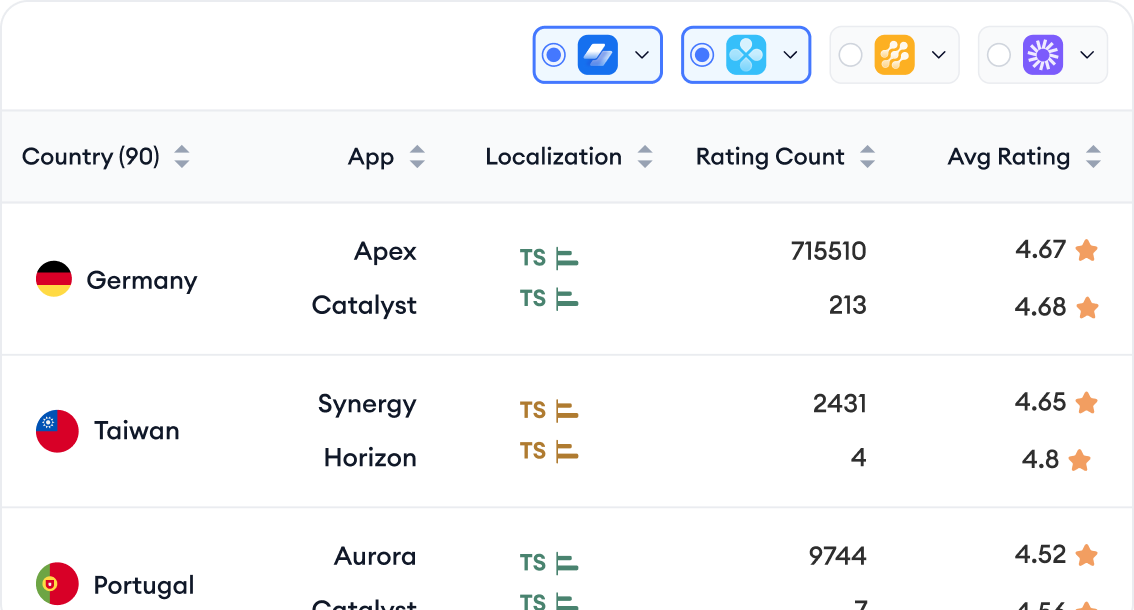
If you want to exponentially grow your user base, localization is the name of the game. Adapting your app store listing for different languages and regions is one of the best ASO tips and tricks to reach new markets without a huge marketing spend. In 2025, simply having an English listing is leaving a lot of opportunity on the table, given the global nature of app stores. Here’s how to approach ASO localization effectively:
True app localization goes beyond translating your app title and description. It means culturalization, ensuring your app’s messaging and visuals resonate with local audiences. For example, the keywords that work in the US might not be the top queries in Japan or Brazil.
Images can also convey cultural nuances. If you’re targeting East Asian markets, you might find that using certain colors or styles increases appeal. Similarly, localizing any text within screenshots or adding region-specific images (maybe a map showing local currency or local landmarks within your app’s UI if relevant) can make users feel “this app is made for me.”
You don’t have to localize into 50 languages overnight. Look at your app’s existing user base or interest, are you already getting some downloads from non-English countries? Start there. Or consider the size of the opportunity: huge markets like China, Japan, South Korea, Latin America, and Europe each have millions of potential users. Pick a few core languages and roll out localized metadata gradually, measuring the impactUse MobileAction’s Localization feature to identify where your app is underperforming relative to demand. Each localization is a new chance to rank in that country’s store for relevant searches, effectively multiplying your app’s visibility.
Localization isn’t a one-off project. Whenever you update your app with new features or seasonal events, update the localized listings too. Show each market that you’re committed. Regularly review user reviews from different countries to catch any feedback about poor translation or requests for localization of content inside the app. Use that feedback to improve both your store listing and the app itself for each locale.
6. Monitor and adapt to changes
The only constant in the app stores is change. From algorithm updates to seasonal trends and competitor moves, the ASO landscape shifts regularly. That’s why one of the most crucial ASO tips and tricks is to set up a system for continuous monitoring your app’s, your competitors’ performance, and being ready to adapt.
Both Apple and Google change how their search and ranking algorithms work over time. These changes can suddenly impact your app’s visibility. For instance, Google Play has in the past increased the weight of certain quality signals like retention or added penalties for keyword stuffing in descriptions. Apple might introduce new features that shift how apps gain visibility.
Monitoring is an ongoing effort. If a competitor’s app suddenly jumps in ranking or hits the top charts, dive into what might have changed. Did they update their app icon to something new? Add an in-app event or special promotion? Perhaps they localized to a new language that brought a surge of users.
7. Measure what matters with ASO analytics and reports
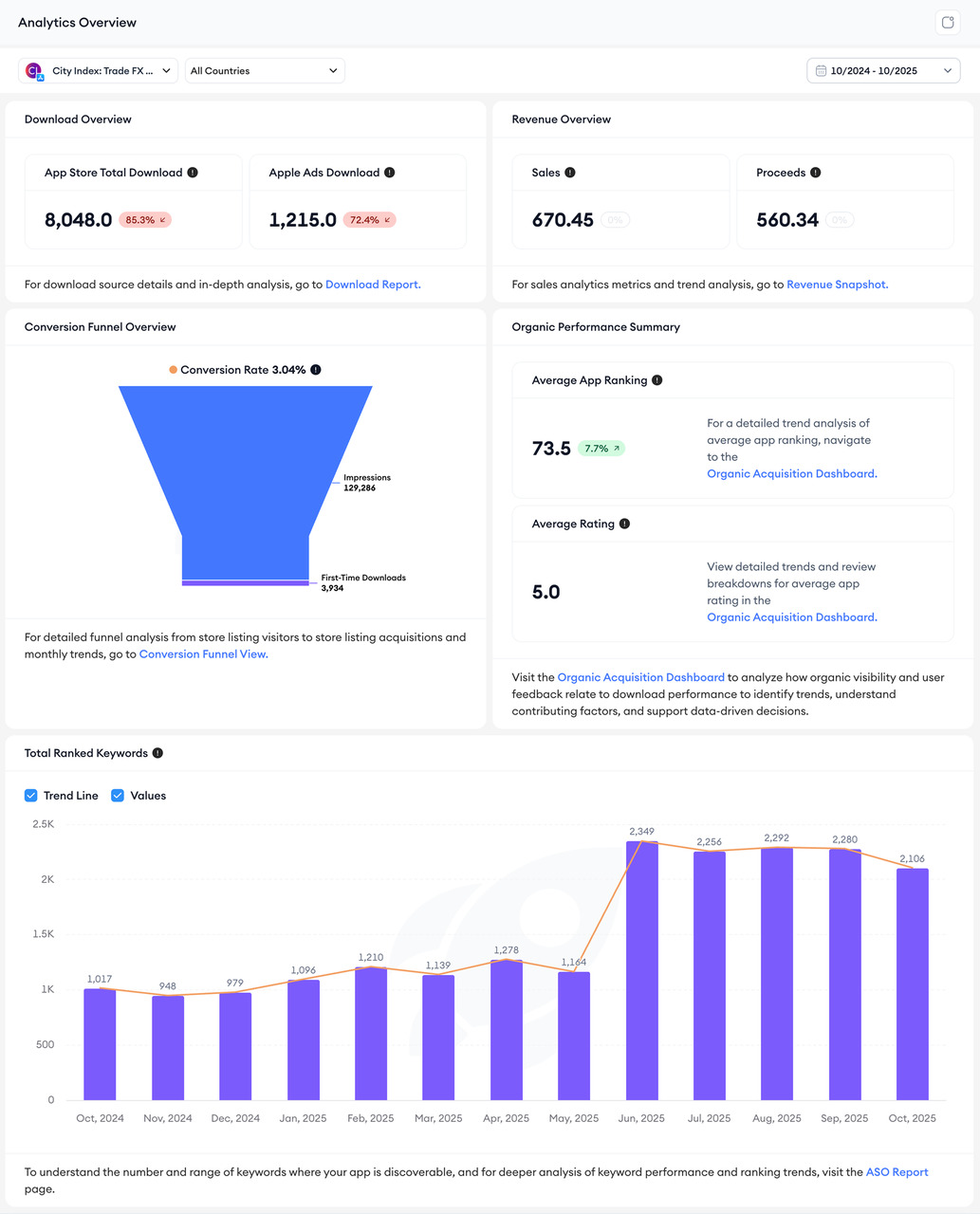
To truly succeed in improving your app store rankings, you need to measure the results of your efforts. “What gets measured gets managed,” as the saying goes. In ASO, that means keeping track of key performance indicators (KPIs) and using specialized reports to understand where you’re winning and where you need to improve.
It’s easy to get lost in data. Determine what your primary goal is for ASO. Is it to rank #1 for a handful of strategic keywords? Is it to increase total organic downloads by X%? Is it to break into the top 10 of a category ranking? Once you clarify that, identify the metrics that matter most for that goal and pay closest attention to them. By aligning metrics to goals, you ensure that your analysis translates into actionable next steps rather than just numbers on a dashboard.
Measuring results might not sound as flashy as other ASO tips, but it’s arguably the most important. Without measurement, you’re flying blind. By leveraging ASO KPIs, you turn your optimization work into a science: you form a hypothesis, implement it, and then see the outcome in the data.
8. Encourage positive reviews and manage your reputation
While keywords and visuals get users through the door, user reviews and ratings often seal the deal, both for user conversion and for the app stores’ ranking algorithms. A well-liked app will organically climb higher, whereas an app with poor ratings might struggle to gain visibility. Thus, managing your app’s reputation is an ASO strategy unto itself.
One of the simplest yet most effective ASO tips is to actively encourage satisfied users to rate your app. Many users won’t think to do it on their own, but if prompted at the right time, they will. Implement an in-app prompt that asks for a review after a positive moment in the app, for example, after a user completes a level, achieves a goal, or has used the app successfully a few times. Timing is key; don’t ask on first launch or after an error. When done right, this can steadily raise your average rating. A higher rating not only convinces more people to download but it can also improve your ranking potential.
Both Apple’s and Google allow developers to respond to user reviews. Take advantage of this to show that you care and to potentially change user perceptions. A polite, helpful response to a negative review can sometimes prompt the user to update their rating. Moreover, prospective customers often read reviews, seeing the developer actively responding builds trust. From an ASO perspective, consistently addressing feedback can improve your rating over time and reduce the impact of occasional one-star rants.
ASO is an ongoing, intelligence-driven journey

We’ve covered a wide array of ASO tips and tricks, from competitive keyword research and creative optimization to localization and review management, all aimed at helping you achieve higher app store rankings. The overarching theme should be clear: effective ASO in 2025 is not a one-time project or a haphazard checklist, but a continuous, data-driven cycle.
The mobile app ecosystem is more competitive than ever, but that also means the rewards for getting ASO right are enormous. By consistently applying these strategies and leveraging the right tools, you can build an ASO machine that keeps delivering results.
Ready to take the next step? If you haven’t already, start your free trial today and incorporate MobileAction into your workflow to execute these tips efficiently!
Frequently asked questions
What is an ASO strategy?
An ASO strategy is a complete plan for improving your app’s visibility and conversion inside the app stores. It covers every part of your app listing, including keyword selection, title, subtitle, descriptions, icons, screenshots, videos, audience research, competitor evaluation, and user feedback management. A proper ASO strategy works similarly to SEO for websites. It starts with research, continues with optimization, and evolves through constant monitoring and refinement. It outlines which keywords to target, how to position the app in the market, how to design or update creatives, how to localize for different regions, and how to maintain user satisfaction since ratings and reviews influence rankings.
What are the ASO tips for 2025?
ASO tips for 2025 focus on combining data, creativity, and ongoing improvement. The most important practices include using competitive intelligence tools to understand which keywords competitors rely on, selecting keywords based on clear performance metrics, optimizing icons and screenshots through frequent testing, adapting your listing for different markets with localized content, and prioritizing user feedback to maintain strong ratings. ASO in 2025 is not a one-time effort but a continuous practice where you track rankings, watch algorithm changes, evaluate competitors, and update your listing based on new trends.
Does ASO really work?
Yes. ASO is one of the most effective ways to increase organic downloads. Most app installs come from people searching or browsing inside the stores, so improving your ranking directly increases your visibility. When ASO is executed correctly, apps can move from low visibility to ranking for high traffic searches, leading to consistent download growth without the cost of paid installs. Developers often see significant gains simply by optimizing their metadata, creatives, and keyword strategy. ASO works because it aligns your app with the searches people already make.

Content Marketing Manager
Resources that you'll love


Grow your app on the App Store and Google Play Store with our solutions now