










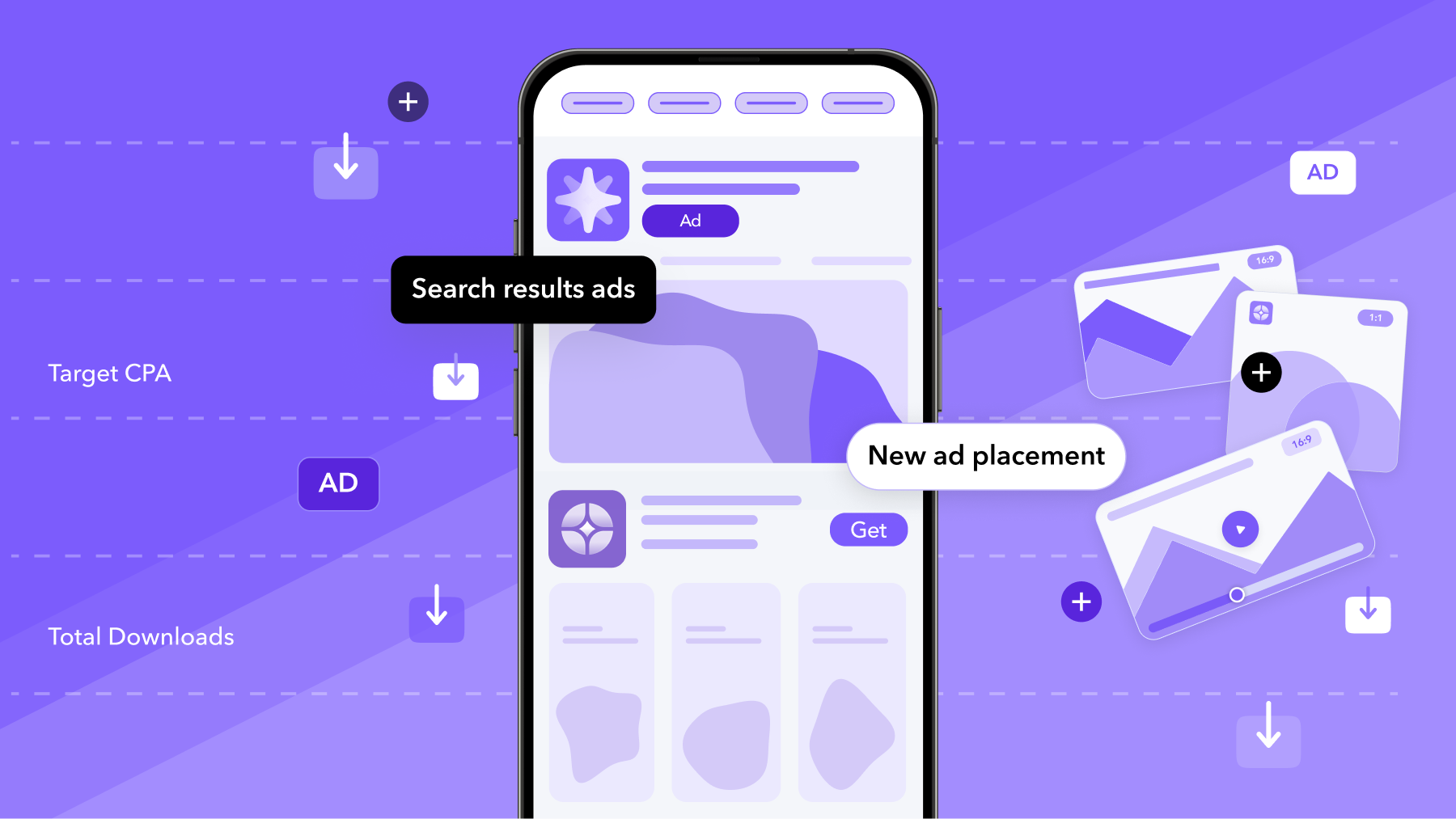
Earlier in 2026, Apple Ads announced two changes affecting how advertisers manage search results campaigns: additional ad placements further down the search results page and Maximize Conversions, an automated bidding strategy built around a target CPA.
Together, these updates expand the opportunities available within search results while changing how campaigns can identify relevant queries and make bidding decisions. But they address different parts of the strategy. Additional placements broaden the available opportunities for ads to appear in search results, while Maximize Conversions automates query matching and bidding toward an average acquisition-cost goal.
Key takeaways
- Additional search results placements expand available opportunities, but advertisers cannot choose or bid for a specific position.
- Maximize Conversions uses Search Match and automated query-level bidding to pursue installs at a target CPA.
- Target CPA is an average performance goal, not a hard per-install ceiling; it should not be treated as a direct replacement for a CPA cap.
- Measure both visibility and outcomes: impression share, spend, CPA, CPT, conversion rate, installs, and downstream quality.
- Test campaign changes before seasonal peaks so learning-period fluctuations do not drive rushed decisions.
What has changed in App Store search results?
Apple Ads search results campaigns can now show ads either at the top of search results or further down the page. This is an inventory expansion within the existing search results campaign structure, not a new campaign type or a separately targetable placement. Apple Ads search results documentation confirms that advertisers cannot select or bid for a particular ad position.
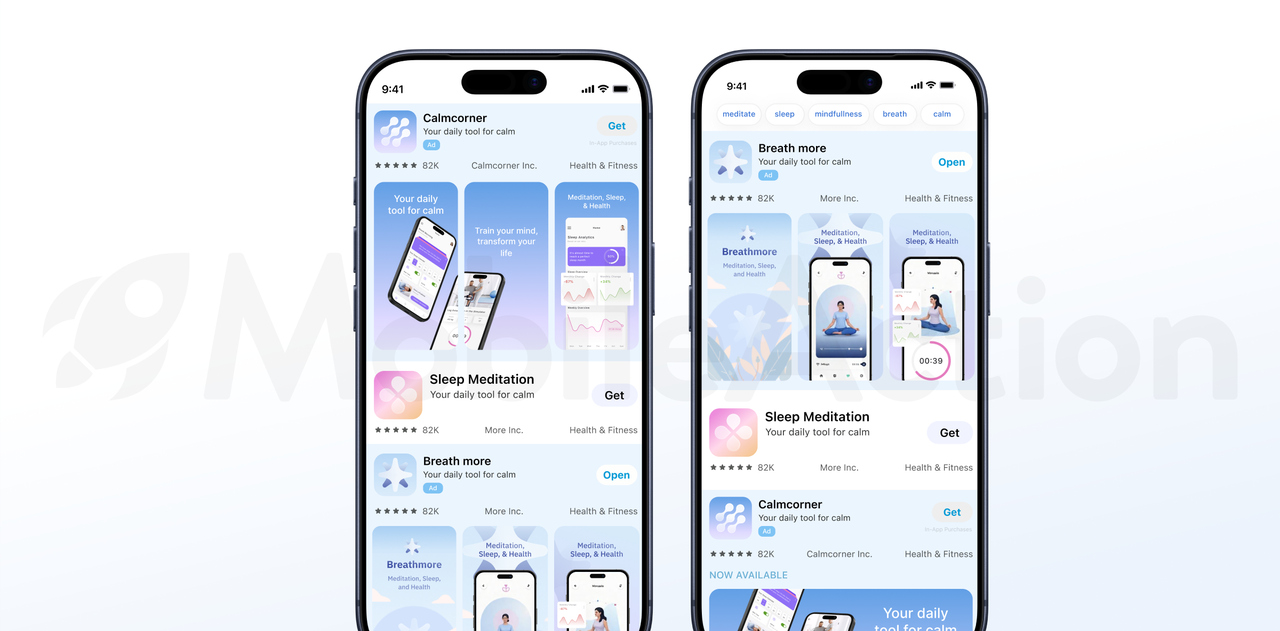
That matters because search remains one of the clearest expressions of App Store intent. More available positions can create more opportunities to appear when a user is actively looking for an app. But additional ad inventory does not mean every app is eligible for every query.
Relevance still comes first. Apple Ads considers both an app’s relevance to the search query and the advertiser’s bid. If an app is not a good match for what the user is searching for, increasing the bid alone will not make it eligible. Although Apple Ads eligibility and organic ranking are separate systems, both benefit from clear metadata, relevant search-term alignment, and a product page that accurately represents the app. For the organic side of this equation, our breakdown of App Store ranking factors explains the signals that can influence an app’s visibility in search results.
The practical implication is straightforward: teams should optimize for relevant coverage, not try to “buy” a placement. That means reviewing:
- Keyword and search-theme relevance
- Product page and custom product page alignment
- Ad variation messaging
- Budget pacing on high-volume queries
- Conversion quality after the install
For a deeper look at the different ad positions, see our article on Apple Ads is expanding search results inventory on the App Store.
What Maximize Conversions changes
Maximize Conversions is Apple Ads’ automated strategy for post-launch search results campaigns. It automatically sets bids and Search Match to identify relevant search queries and set bids based on the likelihood of generating installs.
Instead of manually setting a max CPT bid for every keyword, advertisers guide the campaign through two primary inputs: target CPA and daily budget.
Apple Ads uses real-time signals to determine an optimal bid for each relevant search query. This can help teams capture opportunities that would be difficult to identify or manage manually, particularly across broader or fast-changing search demand.
Search Match is central to this approach. It allows Apple Ads to match an ad to relevant queries without requiring advertisers to build and actively bid on every possible keyword. That does not mean advertisers give up all strategic control: campaign structure, alignment with the product page, negative keywords where appropriate, target CPA, and budget still shape the quality and scale of the campaign.
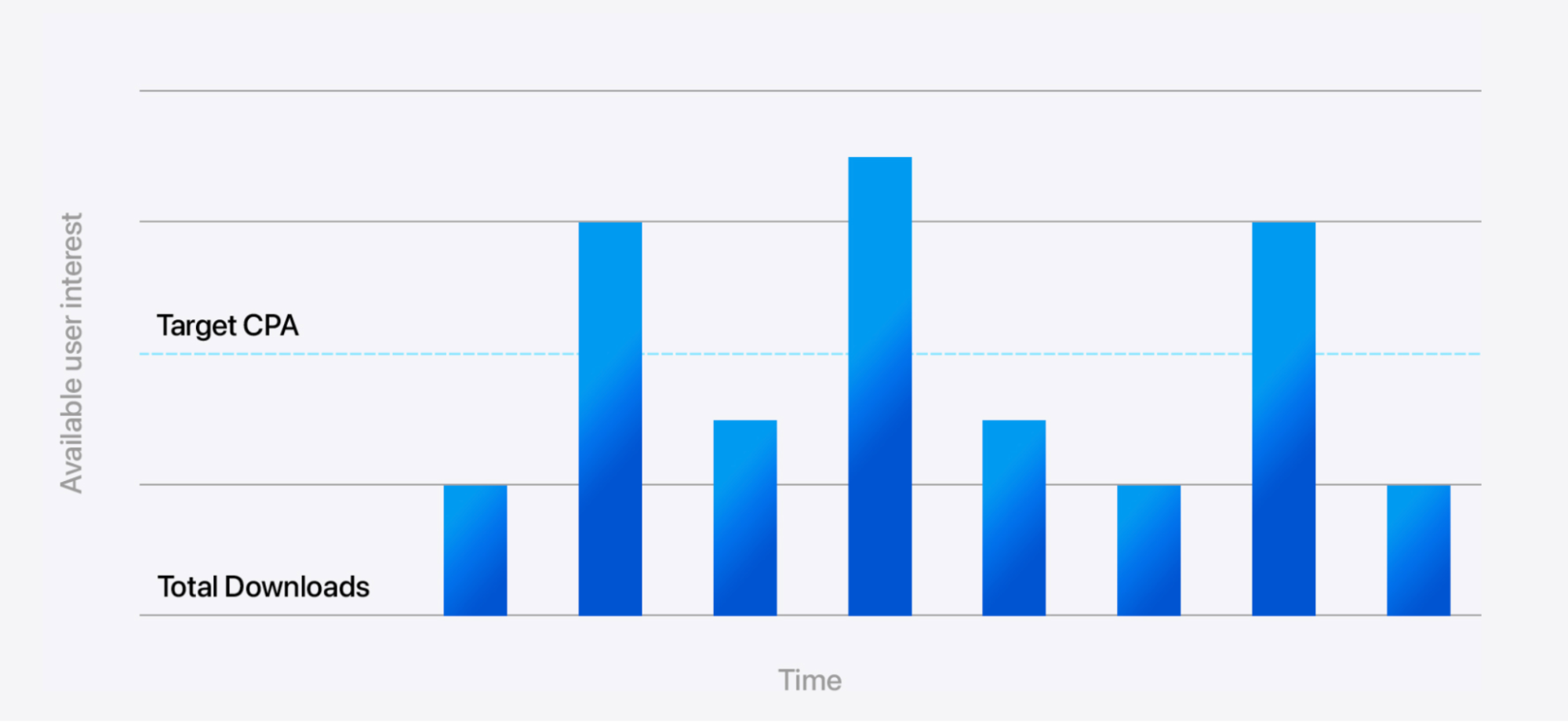
Target CPA is a target, not a cap.
Apple Ads aims to drive downloads at the target CPA on a weekly basis. Daily CPA may land above or below that target, especially during learning or when auction conditions change.
Apple Ads recommends setting a daily budget that can support at least five conversions per day and allowing Maximize Conversions campaigns to run for at least two weeks before evaluating their impact. A campaign with too little budget or too little conversion volume may not have enough signal to learn reliably.
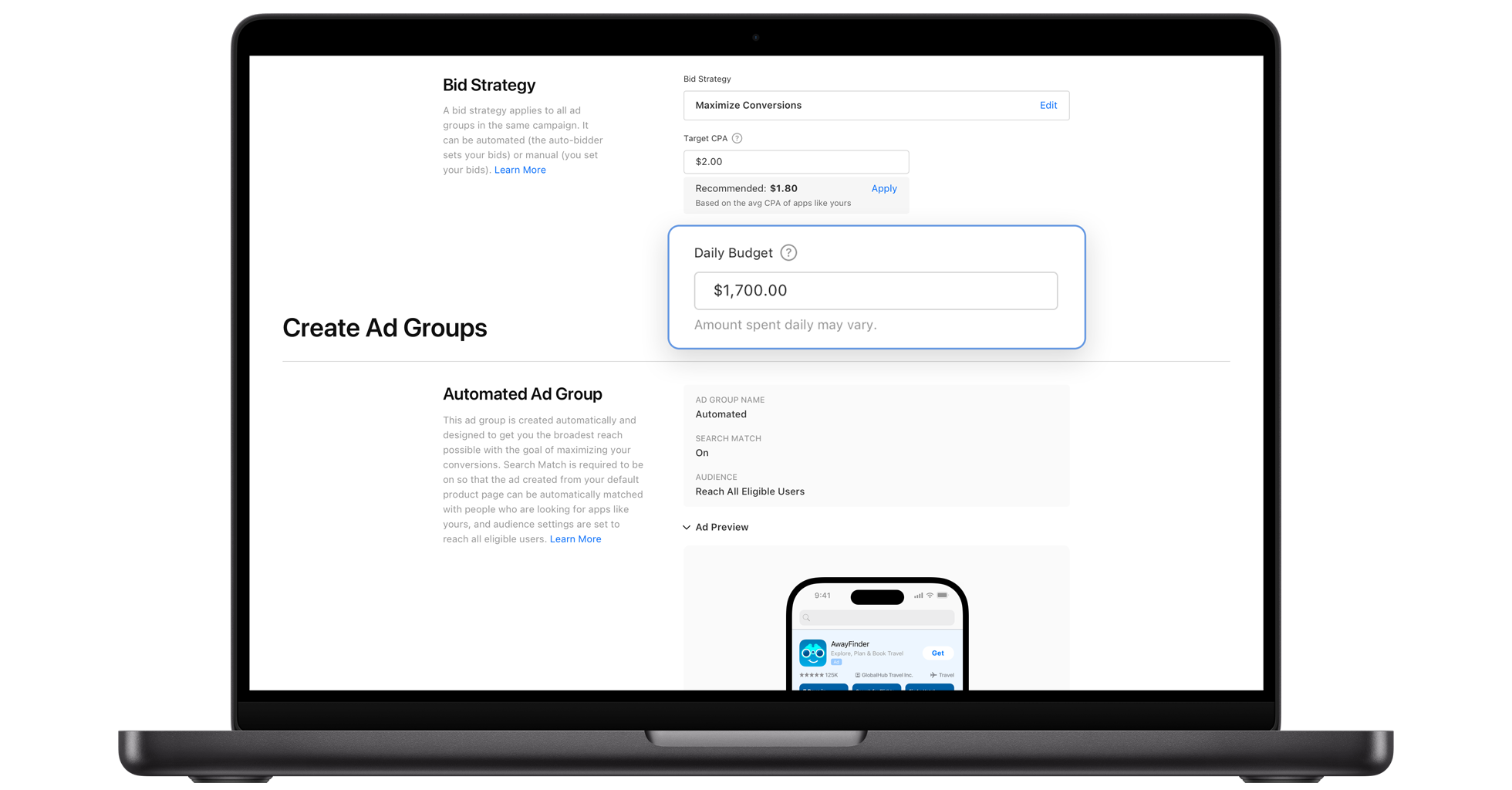
For setup details and practical optimization guidance, read MobileAction’s article on Maximize Conversions.
Why additional placements and Maximize Conversions need one operating model
Additional placements and Maximize Conversions should be planned together because both affect the total opportunity set in search results. But they are not interchangeable.
| Change | What it affects | What advertisers control | What advertisers cannot control |
| Additional search results placements | Available opportunities for ads to appear in search results and visibility distribution | Relevance, campaign quality, budget, and creative/message match | A specific search results position |
| Maximize Conversions | Query matching and bid decisions | Target CPA, daily budget, and negative keywords where appropriate | Individual automated bids for each query |
More inventory may create more opportunities to spend. Automation may help a campaign find more relevant opportunities. Neither change removes the need for strategic decisions.
Teams still need to decide which search themes deserve a budget, which queries need to be excluded, whether the product page search matches user intent, and which downstream outcomes define a valuable install. The right question is not, “Did we get more impressions?” It is, “Did broader search visibility produce incremental, qualified installs at a sustainable cost?”
Creative alignment is especially important here. Apple Ads can create a default ad from an app’s product page, while custom product pages can support more tailored ad variations for specific audiences and keyword themes. Because screenshots can appear directly in search results and shape a user’s first impression before the tap, teams should make sure their assets are both technically compliant and aligned with the intended search theme. Our App Store screenshot sizes and guidelines cover the current requirements and creative best practices. A search strategy becomes stronger when the query, ad experience, and product page tell the same story.
When to use Maximize Conversions versus Manage Bids
Maximize Conversions is not universally better than Manage Bids. The better choice depends on the campaign’s objective, conversion data, budget, and required level of control.
| Choose Maximize Conversions when… | Choose Manage Bids when… |
| The app is post-launch and the goal is to scale relevant install volume. | The team needs direct keyword-level and max CPT control. |
| The campaign has enough expected conversion volume and budget to support learning. | The keyword strategy is tightly segmented and requires manual bid decisions. |
| Search Match can help uncover relevant demand beyond a manually maintained list. | The campaign needs highly deliberate bid management for particular terms or segments. |
| The team wants to reduce day-to-day keyword-bid maintenance. | The app is available for pre-order, where Apple recommends manual bidding. |
Maximize Conversions is best evaluated at the campaign level over time. It is designed to optimize query-level bids automatically, so judging it by one day’s CPA movement or one keyword’s delivery can lead to false conclusions.
Manage Bids remains useful for teams that need granular control or want to preserve an intentional keyword structure. In many accounts, the right answer may be a measured test rather than a full, immediate migration.
Prepare CPA-cap campaigns for transition
CPA cap and target CPA sound similar, but they work differently.
A CPA cap applies at the ad group level and creates a bid ceiling across the keywords in that ad group. According to Apple Ads CPA cap guidance, a cap can limit impressions and installs, and it does not guarantee that actual CPA will remain below the amount entered.
Target CPA, by contrast, is used by Maximize Conversions as an average efficiency goal. The system can bid higher on a query that looks more likely to convert and lower on another query, while aiming to achieve the target over time. Daily budget remains the overall spending control.
Apple Ads has stated that CPA caps will soon become unavailable. That does not mean teams should copy their current cap into a target CPA field and expect the same behavior. Before making a change, use a deliberate transition process:
- Record a baseline: max CPT bids, CPA cap, actual CPA, spend, installs, conversion rate, and visibility.
- Decide whether the campaign should remain under Manage Bids or move to Maximize Conversions.
- If removing a CPA cap, reassess bids first. Apple Ads recommends waiting at least one day for bid changes to take effect before removing the cap.
- If testing Maximize Conversions, allow enough time for learning before comparing it with the baseline.
This preserves a clean measurement window and helps teams separate a bidding-strategy change from seasonal demand, creative changes, or budget increases.
Measure visibility and performance at the right level
The expanded search results environment makes position-aware reporting more valuable, but different tools answer different questions.
Apple Ads’ first-party Impression Share reporting includes:
- Impression Share (All Ad Positions): how often an ad was shown in any available ad position for a search term, compared with total searches for that term.
- Impression Share (First Ad Position): how often an ad was shown specifically in the first position.
Apple Ads reports these metrics as percentage ranges, not exact percentages. They are useful for understanding first-party visibility across search terms and markets.
MobileAction provides a complementary competitive view across additional placements. This helps teams see how paid visibility is distributed across placements, apps, keywords, and competitors. These views should not be added together to calculate Total Impression Share; each metric has its own methodology and purpose.
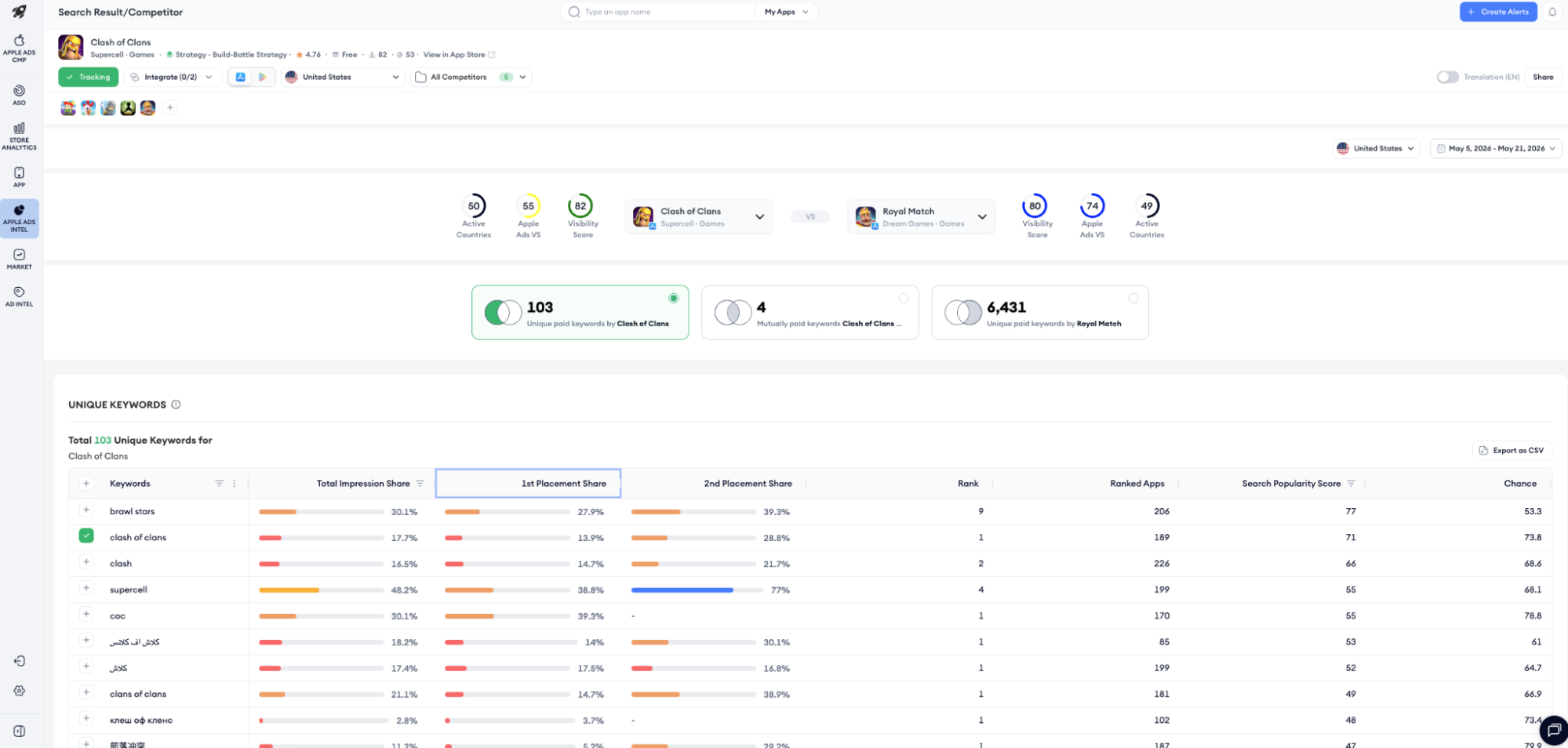
Keep these Apple Ads metrics separate from other App Store discovery surfaces. In-App Events, for example, can also appear in search results and on product pages, but they follow their own creative requirements and measurement framework in App Store Connect. Our In-App Events guide explains how these formats work.
Visibility should then be read alongside performance outcomes:
- Spend and pacing
- Average CPA and average CPT
- Tap-through rate and conversion rate
- Installs and redownloads
- Search-term performance and match source
- Relevant post-install metrics from the advertiser’s MMP or internal measurement stack
For a broader framework covering Apple Ads Insights and App Store Connect Analytics, see our breakdown of what’s new in Apple Ads Insights and App Store Connect Analytics.
How Maximize Conversions drove more installs at a lower CPA
A leading German retail advertiser working with MobileAction moved an eligible search results campaign from Manage Bids to Maximize Conversions with a target CPA.
Before the transition, the team documented a baseline that included daily budget, spend, installs, average CPA, conversion rate, and conversion volume. Following the change, the campaign was given time to learn and adjust before equivalent pre- and post-transition periods were compared.
The campaign recorded:
- 26% more installs
- 6% lower average CPA
- 18% higher spend
The advertiser generated additional install volume without a proportional increase in average acquisition cost. However, this was one anonymized campaign under its own account conditions, budget, category, market, and comparison periods. The result should not be treated as a benchmark, forecast, or guarantee for other advertisers.
The wider lesson is about evaluation discipline. A bidding transition should be assessed against an established baseline, over an appropriate period, and alongside the amount of incremental spend required to generate the additional volume.
Conclusion
The new search results environment requires a more intentional combination of query relevance, bidding strategy, target CPA, budget sufficiency, creative alignment, and placement-aware measurement. Additional placements can widen the opportunity set, while Maximize Conversions can help teams respond to it with more flexible matching and bidding.
The teams best positioned for peak demand will be the ones that test early, protect measurement discipline, and keep human judgment focused on the decisions automation cannot make: what constitutes a valuable user, where budgets should go, and how each search experience should support the product’s broader growth strategy.
As campaigns become more dynamic, MobileAction automation features for Apple Ads campaigns can also help teams monitor performance signals and apply repeatable operational rules without losing strategic oversight.
Frequently asked questions
Can advertisers choose the search results position where an ad appears?
No. Apple Ads states that an ad may appear in any available search results position, and advertisers cannot select or bid for a particular position. Relevance and bid are among the factors that determine whether an ad is eligible to display.
Is target CPA a hard limit on acquisition cost?
No. Target CPA is an average objective. Maximize Conversions works toward the target on a weekly basis, so daily and individual acquisition costs may be higher or lower. The daily budget controls the campaign’s overall spending.
Is Maximize Conversions suitable for pre-order campaigns?
Not currently. Apple Ads describes Maximize Conversions as a strategy for post-launch campaigns and recommends the manually managed bid strategy for apps available for pre-order.
When will CPA caps become unavailable?
Apple Ads states that CPA caps will soon become unavailable, but its current public documentation does not specify an exact date. Advertisers should begin reviewing affected campaigns without presenting an unconfirmed deadline as official.

Content Marketing Specialist
Resources that you'll love




Grow your app on the App Store and Google Play Store with our solutions now