











Methodology note: MobileAction’s Volume, Difficulty, and placement-level Impression Share figures referenced in this article are proprietary estimates derived from MobileAction’s own data collection and modeling. They are not metrics provided by Apple and may differ from first-party Apple Ads or App Store Connect data.
A holiday-season Apple Ads strategy should be prepared before seasonal demand begins. It should identify where additional investment is most likely to create value, including the relevant countries or regions, categories, keyword groups, and search themes.
Once these priorities are clear, the strategy should define how campaigns will capture that demand. This includes selecting the appropriate bid strategy, setting and distributing daily budgets, choosing relevant App Store ad placements, and accounting for search results ads that may appear either at the top of the page or further down the results.
Measurement should also be planned in advance. Establish baseline periods, key metrics, and comparison methods for evaluating performance before, during, and after the holiday season.
These decisions should be based on historical campaign performance, current search demand, conversion data, budget limits, and business priorities. Because seasonal demand varies by app and market, each country or region should be assessed separately rather than assuming that every market will experience the same holiday uplift.
Key takeaways
- Build the holiday plan around category, market, keyword, and account-level evidence rather than assuming demand will increase everywhere.
- Use MobileAction to identify keyword momentum, competitor activity, placement-level Impression Share, and relevant category, country or region, and ad placement benchmarks.
- Use Apple Ads’ first-party Impression Share metrics to evaluate overall and first-position visibility, and use MobileAction’s estimated placement-level metrics to understand how visibility is distributed across the first and additional search results positions.
- Choose between Max Conversion Campaigns or Manage Bids based on to the campaign objective, available data, budget, and required level of keyword control.
- If a campaign currently relies on a CPA cap, prepare for a possible transition to Maximize Conversions without treating target CPA as a direct replacement for the CPA cap.
- Calculate holiday funding from daily campaign requirements, separating baseline investment, seasonal expansion, and a controlled reserve.
- Give each ad placement on the App Store a specific role based on user context, campaign objective, creative message, destination, and measurement approach.
- Protect baseline performance while increasing spend, and evaluate visibility alongside CPA, conversion performance, and lower-funnel KPIs.
1. Build the plan from evidence, not a universal holiday assumption
Start by identifying the seasonal moments that are relevant to your app and market. Black Friday may be central to shopping apps, while a gaming app may focus on content releases, gifting periods, school holidays, or device activation periods.
MobileAction’s keyword data can help identify when demand for a seasonal search theme begins to change. On the App Store in the U.S., MobileAction’s Keyword Inspector estimated that search volume for “christmas gifts” on the U.S. App Store remained relatively stable through October and early November. It began increasing in the second half of November, continued rising throughout December, and peaked around December 22 before declining sharply after Christmas.
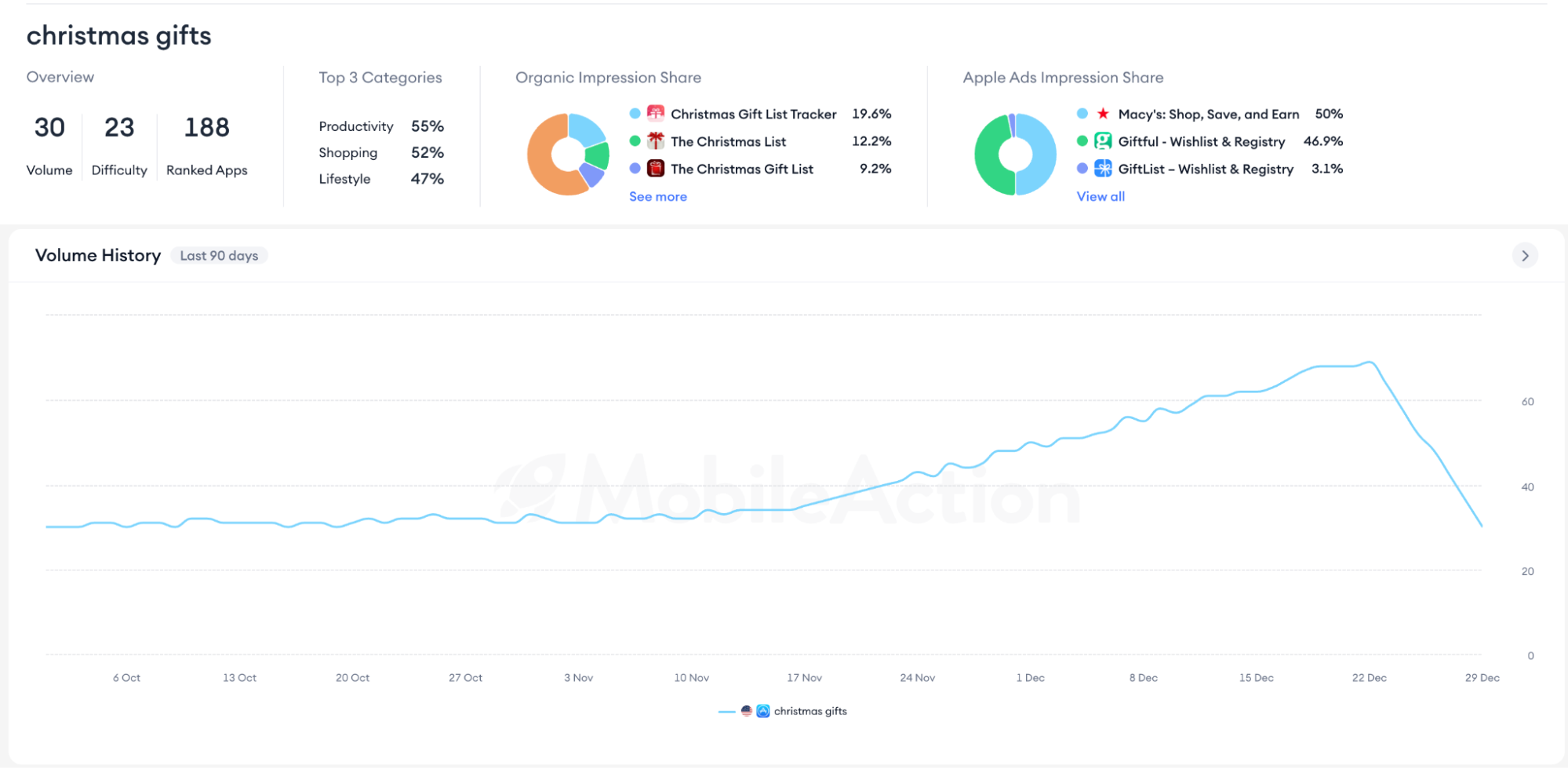
At the time captured, MobileAction reported a Volume score of 30, a Difficulty score of 23, and 188 ranked apps for the keyword. Productivity, Shopping, and Lifestyle were the leading associated categories. Organic Impression Share was distributed across several gift-list applications, while Apple Ads Impression Share was concentrated primarily between Macy’s and Giftful, which accounted for 50% and 46.9% of paid visibility respectively.
The pattern shows why November and December should not be treated as a single period of uniform demand. Interest in Christmas-related search themes may begin increasing several weeks before the holiday, continue building through most of December, and decline quickly once the relevant occasion has passed. This timing can inform when advertisers expand keyword coverage, increase daily budgets, review bids, activate seasonal ad variations created from custom product pages, and monitor competitor visibility. For more detailed guidance on creating and using custom product pages for campaign-specific ad variations, see our custom product pages guide.
The keyword trend represents search-interest momentum rather than total App Store downloads or a forecast of campaign results. Advertisers should validate the opportunity against their own Apple Ads, App Store Connect, and MMP data to determine whether the increase in search volume also produced higher impressions, taps, installs, conversions, and downstream business value.
Use MobileAction to identify where seasonal opportunities may be developing:
- Which keywords are gaining search momentum in the relevant App Store category, and in which countries or regions?
- How do keyword trends differ across the countries or regions being considered for additional investment?
- Which commercially relevant keywords are competitors targeting, and where are they capturing stronger paid visibility?
- How is visibility distributed across the first ad position and additional ad positions for your app and its competitors?
- How do your CPA, CPT, conversion rate, and tap-through rate compare with benchmarks for the relevant category, country, and ad placement?
Use these signals to identify markets, search themes, and visibility gaps that deserve further investigation. Validate any opportunity against your own Apple Ads performance and post-install data before making budget decisions. Do not treat these signals as forecasts of future installs or revenue.
Create a seasonal demand map containing:
| Planning input | Question to answer |
| Market | Where did meaningful demand or business value appear? |
| Timing | When did performance begin changing? |
| Search theme | Which brand, category, competitor, or use-case searches mattered? |
| Campaign result | What happened to impressions, installs, CPA, and spend? |
| Business result | Did acquired users complete the intended in-app action? |
| Confidence | Is the pattern supported by enough data to inform this year’s plan? |
How seasonal events can change App Store search demand
MobileAction keyword trend data can be used to identify when interest in a holiday-related search term begins to change.On the App Store in the U.S., the volume history for the keyword “black friday” remained relatively stable from early September through late October. Search volume began increasing in early November and accelerated during the second half of the month, reaching its highest level around the Black Friday period before beginning to normalize.
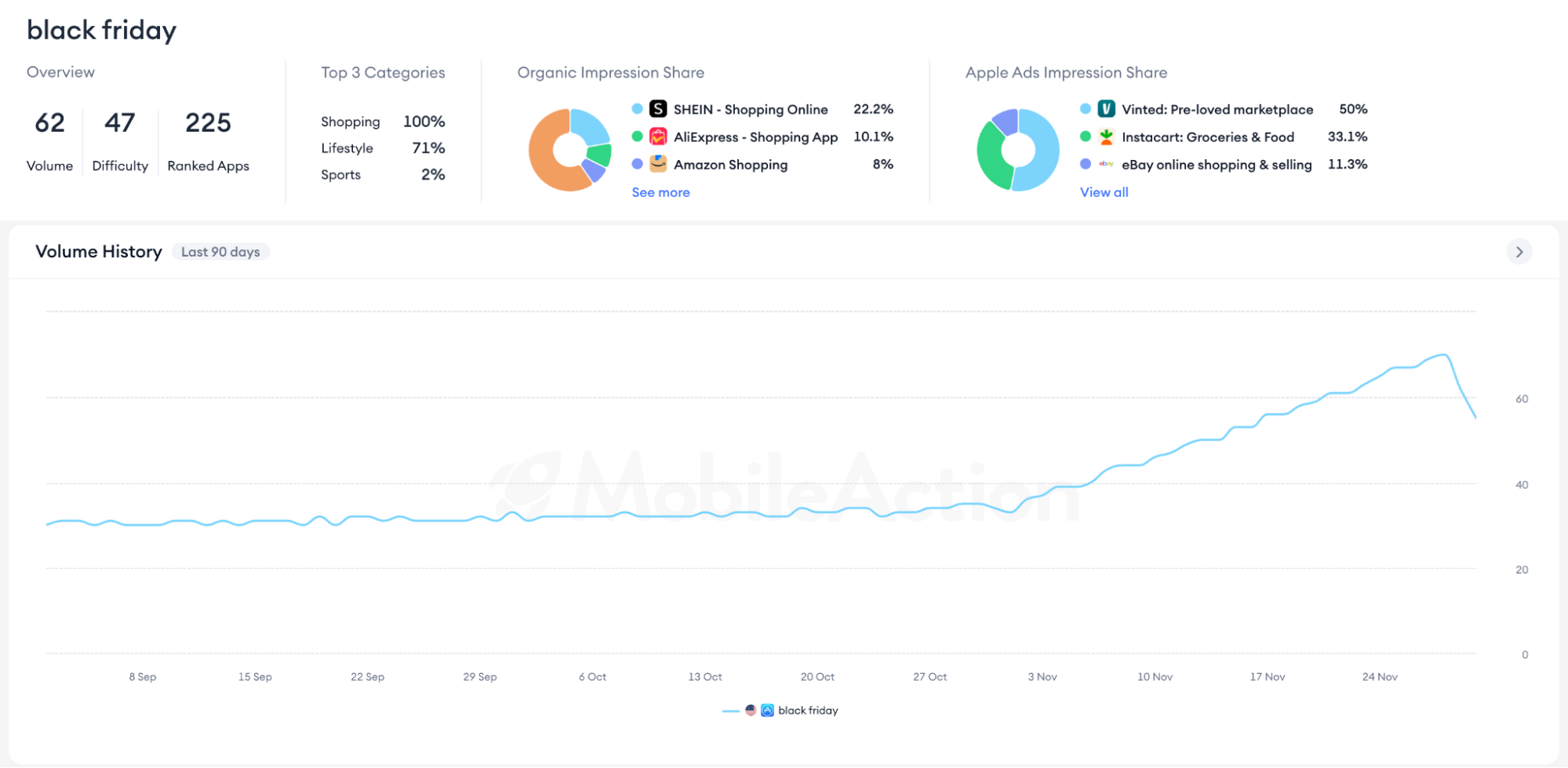
MobileAction’s Keyword Inspector: search volume for “black friday” on the U.S. App Store
At the time captured, MobileAction reported a volume score of 62, a difficulty score of 47, and 225 ranked apps for the keyword. Shopping was the primary category associated with the term. The Apple Ads Impression Share view also showed that paid visibility was concentrated among a limited number of advertisers, including Vinted, Instacart, and eBay.
This example provides keyword-level evidence of how seasonal search interest can develop before a major commercial event. It does not represent total App Store downloads or guarantee that higher search volume will result in additional installs or revenue. Advertisers can use the timing of the increase to determine when to expand keyword coverage, prepare additional campaign budget, review bid levels, and monitor how visibility is distributed across search results positions.
2. Account for the updated search results environment
Search results ads can now appear either at the top of the results or further down the page. To learn more about this update and how it affects search results visibility, read our article, Apple Ads’ expanded search results inventory. To learn more about this update and how it affects search results visibility, read our article, Apple Ads’ expanded search results inventory.
Advertisers cannot select or bid for a particular position. Whether an ad participates in an auction depends on factors including the app’s relevance to the search query and the bid. Increasing a bid does not make an irrelevant app eligible to appear.
This changes how visibility should be evaluated. A search results strategy should no longer use first-position exposure as the only indicator of coverage. Review both:
- Impression Share (All Ad Positions): how often the ad appeared in any position for a search term compared with total searches for that term in the same countries or regions.
- Impression Share (First Ad Position): how often the ad appeared in the first position for that search term.
With MobileAction, teams can analyze Total Impression Share alongside visibility across the first ad position and additional placement at the app, keyword, and competitor levels. This breakdown helps show whether an app’s visibility is concentrated in the first ad position, supported by the additional placement, or distributed across both.
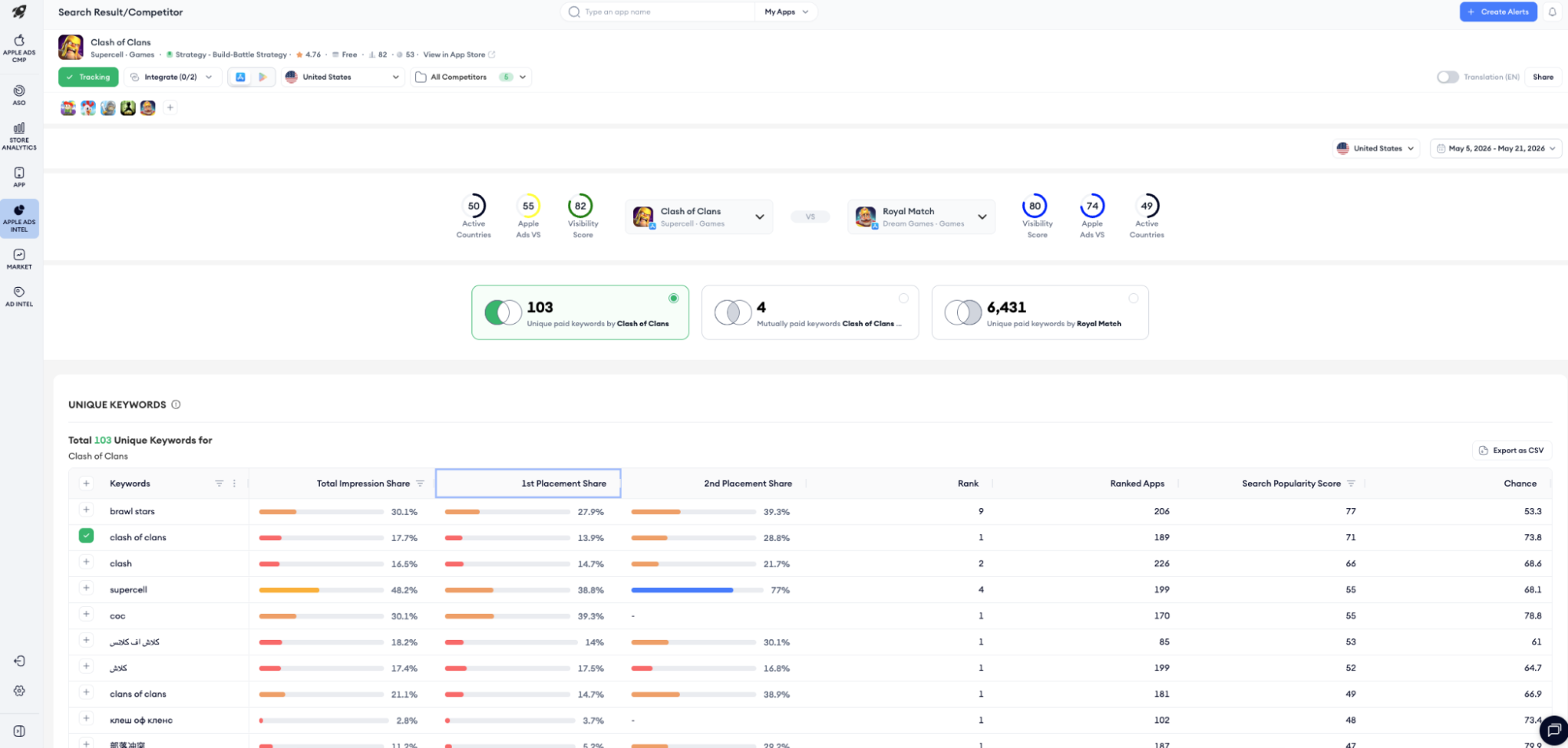
Note that Total Impression Share is an aggregate metric and should not be calculated by adding Impression Share from the first ad position and additional placement together.
Review search results campaigns by intent
Before increasing holiday budgets, group search activity according to the role it plays:
- Brand demand related directly to the app or company.
- Category demand describing the app’s function or genre.
- Competitor-related demand.
- Discovery activity intended to uncover additional relevant search terms.
- Seasonal themes related to promotions, gifting, new content, events, or time-sensitive use cases.
Then review whether the app metadata, keyword strategy, ad variation, and destination accurately match each intent. Apple Ads considers app relevance when determining whether an ad is eligible to participate in an auction.
Search results ads can use a default ad based on the app’s product page or ad variations based on custom product pages. A custom product page with a deep link can also direct users to a specific place in the app on supported operating systems.
The objective is not to create a variation for every possible search term. Prioritize themes with a distinct audience need, seasonal message, or in-app destination.
3. Select the appropriate search results bid strategy
Apple Ads offers two bid strategy options for search results campaigns:
- Maximize Conversions, which uses an auto-bidder and Search Match.
- Manage Bids, which allows manual keyword selection and bid control.
The choice should be based on the campaign’s purpose, available data, budget, and required level of control.
Maximize Conversions
Maximize Conversions uses real-time signals to calculate bids for relevant search queries and uses the Search Match feature to prioritize terms likely to result in installs. Advertisers set a target CPA rather than individual keyword bids.
Target CPA is the ideal amount the advertiser wants to spend per install. The strategy is designed to drive downloads at that target on a weekly-average basis. Actual daily CPA may be above or below the target.
Do not wait until the most important promotional days to begin evaluating the strategy. The campaign needs sufficient time and conversion volume for the system to learn and adjust.
A target CPA should also be commercially realistic. Setting it substantially below recent CPAs may restrict the campaign’s available opportunities, particularly if the daily budget is also limited.
For a more detailed explanation of target CPA, Search Match, campaign setup, and optimization considerations, read our guide to Maximize Conversions for Apple Ads search results campaigns.
How a leading German retail brand used Maximize Conversions
A leading German retail brand working with MobileAction transitioned an eligible search results campaign from Manage Bids to Maximize Conversions with a target CPA. The objective was to increase conversion volume while maintaining acquisition costs within a commercially sustainable range.
Before the transition, the MobileAction team and the advertiser established a performance baseline using the campaign’s daily budget, spend, installs, average CPA, conversion rate, and conversion volume. After the campaign moved to Maximize Conversions, the team allowed sufficient time for the Apple Ads bidding system to learn and adjust before comparing equivalent pre- and post-transition periods.
Using MobileAction’s CMP, the team monitored weekly performance, compared results across the selected periods, and evaluated whether the target CPA and daily budget were aligned with the advertiser’s intended conversion volume. This helped the advertiser assess the strategy based on sustained campaign performance rather than short-term daily CPA fluctuations.
Following the transition, the campaign achieved a 26% increase in installs, while its average CPA decreased by 6%. During the same period, campaign spend increased by 18%, indicating that the advertiser was able to generate additional conversion volume without a proportional increase in acquisition costs.
The advertiser’s identity and account details have been anonymized. Results reflect this specific campaign and should not be interpreted as a guarantee of similar performance for other advertisers.
Manage Bids
Manage Bids is appropriate when the advertiser needs direct control over keyword selection and max CPT bids. It can also remain relevant when campaign structure, keyword segmentation, or specific search-term control is central to the strategy.
For pre-order apps, Apple Ads guidance recommends manual bidding because Maximize Conversions is currently designed for post-launch campaigns.
Manage Bids should not be treated as the default simply because it is familiar. Compare the operational effort required to manage keywords and bids with the campaign’s need for automation, discovery, and scale.
4. Prepare for the transition away from CPA cap
Apple Ads has confirmed that CPA caps will soon be unavailable, making it important for advertisers currently using them to prepare for the transition.
CPA cap and target CPA are not interchangeable controls.
A CPA cap is an optional ad-group-level setting in search results campaigns. It creates a bid ceiling across the keywords in the ad group.
Target CPA works differently. In a Maximize Conversions campaign, Apple Ads automatically adjusts bids across eligible search queries to work toward the advertiser’s target CPA. Advertisers do not set individual keyword bids; they set a target CPA and daily budget, which controls overall campaign spending.
Holiday plans should therefore identify campaigns that currently rely on CPA caps and determine whether they should continue with Manage Bids or transition to Maximize Conversions.
For each affected campaign:
- Record the existing max CPT bids, CPA cap, actual CPA, conversion volume, and Impression Share.
- Decide whether the campaign should continue with Manage Bids without a CPA cap or whether Maximize Conversions is more suitable.
- Reassess whether existing keyword bids remain appropriate once the cap is removed.
- Monitor spend and acquisition cost after the change.
5. Build the holiday budget from daily campaign requirements
Apple Ads campaigns use a daily budget to represent the average amount the advertiser wants to spend per day over the course of a month. Spend may exceed the daily budget on days when there are more opportunities, but monthly spend will not exceed the daily budget multiplied by 30.4, average number of days in a calendar month according to Apple Ads guidance.
The basic monthly planning calculation is:
Maximum monthly campaign spend = daily budget × 30.4
For campaigns with an end date, spend will not exceed the number of campaign days multiplied by the daily budget. Campaigns without an end date continue into subsequent months unless they are paused or removed.
Create three budget layers
A practical holiday budget can be divided into three layers.
Baseline budget
The amount required to maintain campaigns and search themes that consistently support the business.
Seasonal expansion budget
Additional funding assigned to markets, themes, placements, or promotions supported by historical evidence and current commercial priorities.
Controlled reserve
Budget held for opportunities identified after campaigns begin, such as higher Search Popularity, improving conversion rates, or low Impression Share on commercially relevant terms.
The reserve should not be distributed based on impression volume alone. Review whether additional visibility is producing acceptable acquisition cost and relevant downstream outcomes.
Use performance benchmarks to inform holiday budget planning
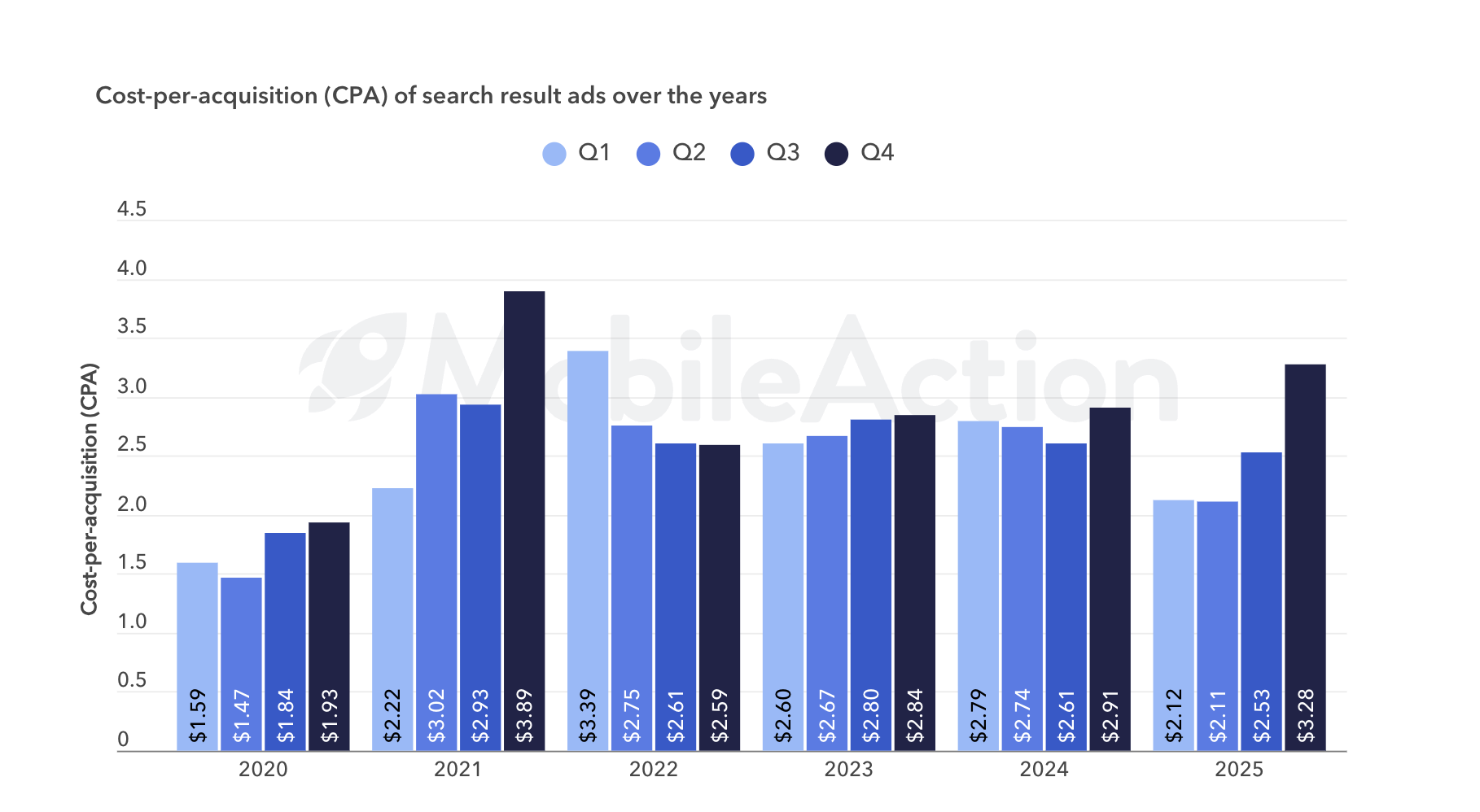
MobileAction’s 2026 Apple Ads Benchmark Report shows that acquisition costs can change materially during the final quarter of the year. Across the report’s aggregated search results ads data, average CPA increased from $2.53 in Q3 to $3.28 in Q4 2025. Search tab ads showed a similar late-year cost increase, with average CPT reaching $1.23 and CPA reaching $2.51 in Q4. These results provide evidence of higher cost pressure in the analyzed dataset, but they should not be interpreted as a universal holiday pattern for every app, category, or market.
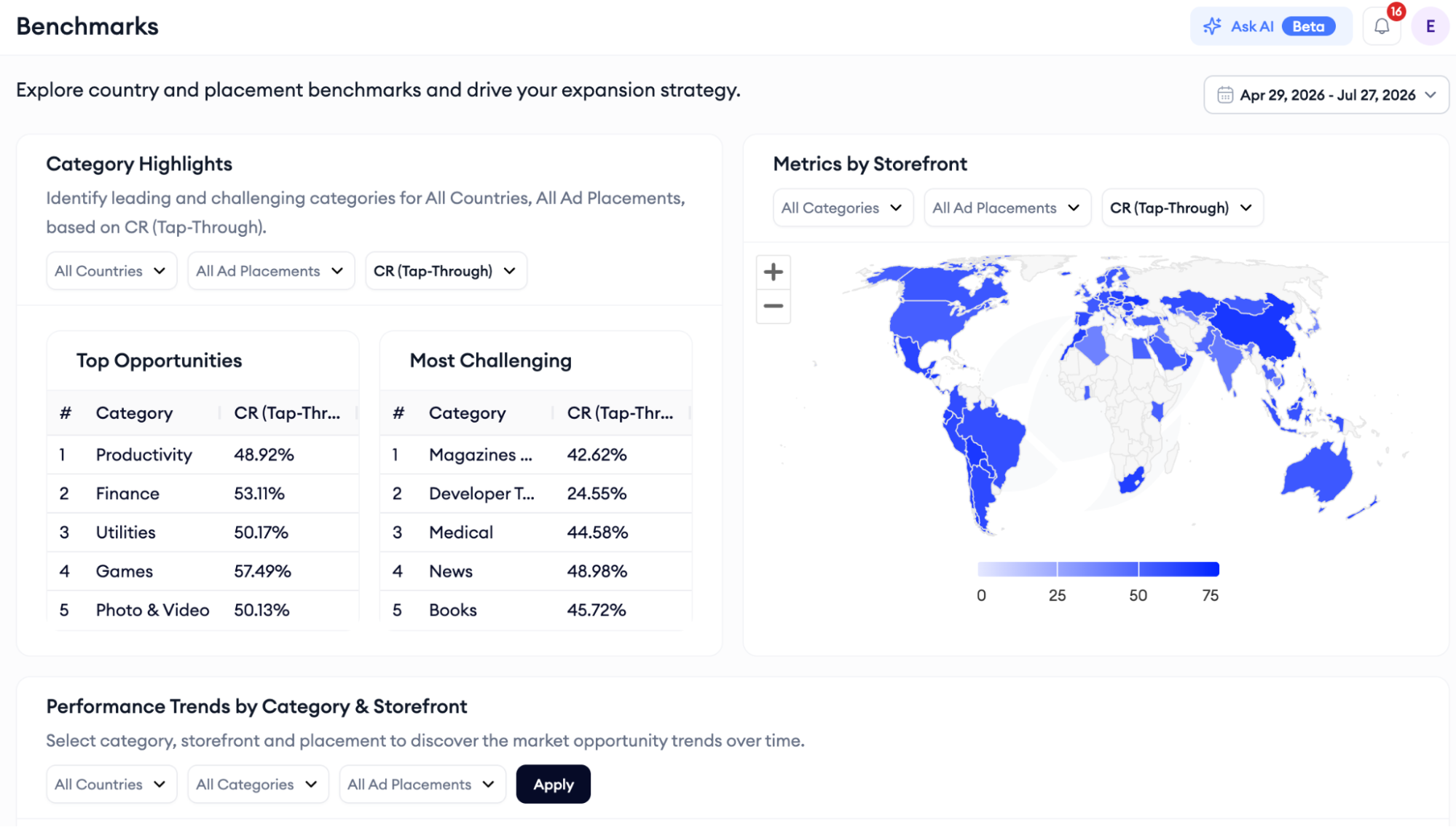
Teams can use MobileAction’s Benchmarks to review CPA, CPT, tap-through rate, and conversion rate for the relevant category, country, ad placement, and date range. These benchmarks can help determine whether campaign assumptions are broadly aligned with industry performance before daily budgets are increased.
Connect budget to target CPA
For Maximize Conversions campaigns, use target CPA and expected daily conversion volume to evaluate whether the daily budget is sufficient.
For example, the planning relationship is:
Required daily budget ≈ target CPA × intended daily conversions
Bear in mind that this is a planning calculation, not a performance guarantee.
If the budget cannot support the intended volume, change one of the planning assumptions before launch. Do not expect the bidding strategy to resolve a budget that is inconsistent with the target CPA and conversion goal.
6. Assign a clear role to each App Store ad placement
Apple Ads offers four ad placements on the App Store:
- Today tab
- Search tab
- Search results
- Product pages
They reach users in different contexts and should not be treated as interchangeable inventory.
| Placement | User context | Planning role |
| Today tab | Users arriving on the front page of the App Store | Broad discovery around a major seasonal message, release, or promotion |
| Search tab | Users before they enter a specific search | Reach people as they begin exploring |
| Search results | Users searching for a specific type of app | Capture and expand relevant search demand |
| Product pages | Users researching apps and viewing product pages | Reach people while they compare or browse related options |
Today tab ads use a custom product page as their tap destination. Search tab ads can use the default product page or a custom product page. Search results support default ads, ad variations based on custom product pages, and eligible deep-linked destinations. Product page ads appear at the top of the You Might Also Like list after users scroll to the bottom of a product page.
A multiple-placement strategy does not mean that every campaign must use every placement. Select placements according to:
- The campaign objective.
- The user context.
- The intended message.
- The destination experience.
- Market and category eligibility.
- Available budget.
- The measurement method.
For example, a seasonal promotion may use Today tab ads or Search tab ads to create awareness, search results ads to capture related intent, and product page ads to reach users who are actively comparing apps.
Keep budgets and reporting identifiable by placement. Without placement-level separation, it becomes difficult to understand whether additional reach is producing incremental value or simply changing the distribution of spend.
7. Define the measurement plan before increasing spend
Holiday performance should be evaluated against a baseline established before budgets and campaign settings are changed. Select comparable pre-holiday, holiday, and post-holiday periods, and use the same attribution approach, campaign dimensions, and performance metrics across each period.
Measure visibility and acquisition performance together. Increased impressions or Impression Share may show that the app captured more of the available opportunity, but additional visibility should be assessed alongside spend, taps, installs, conversion rate, average CPA, and the post-install outcomes that matter to the business.
MobileAction can be used to compare performance across campaigns, countries or regions, and ad placements, while Apple Ads and the advertiser’s MMP provide the first-party acquisition and post-install data needed to validate the results. The objective is to determine not only whether seasonal activity increased scale, but whether that scale was achieved at an acceptable acquisition cost and produced relevant downstream value.
Before the seasonal period begins, define the conditions that would justify increasing, maintaining, reallocating, or reducing budget. This prevents short-term changes in spend, CPA, or Impression Share from driving decisions without sufficient context.
Conclusion
Maximum visibility on the App Store does not mean appearing in every position or increasing spend across every campaign. It means building relevant coverage across the markets, search themes, ad placements, and user intents that support a defined holiday objective.
MobileAction can help identify keyword momentum, competitive visibility, placement-level Impression Share, and relevant benchmarks. These signals should guide where to investigate and invest, while Apple Ads performance and post-install outcomes determine whether additional visibility is creating meaningful value.
A strong holiday strategy connects demand evidence, campaign intent, bidding, daily budgets, placement roles, and measurement before seasonal activity peaks. This gives teams a clearer basis for deciding where to expand, where to maintain control, and where additional investment is most likely to support sustainable growth.

Content Marketing Specialist
Resources that you'll love



Grow your app on the App Store and Google Play Store with our solutions now