










This handbook will serve as your roadmap, packed with emerging trends, valuable insights, and the best ASO tools & resources. It aims to help you stay ahead of the competition and enhance your app marketing strategy for substantial growth in 2025 and beyond.
Apple Ads helps developers promote apps on the App Store. In 2026, the platform extends beyond keyword-based search results campaigns, giving app marketers access to multiple placements across the Today tab, Search tab, search results, and product pages while browsing.
This Apple Ads guide explains how the platform works today and how app marketers can approach it with a clear, scalable strategy. It covers placement selection, campaign structure, keyword strategy, bids and budgets, custom product pages, performance metrics, and the connection between paid acquisition and ASO.
By the end of this guide, app marketers will have a practical understanding of how Apple Ads works, how first campaigns are typically launched, which beginner mistakes to avoid, how to interpret metrics, which areas to optimize as campaigns begin to scale and more.
What is Apple Ads?
Apple Ads is an advertising platform for promoting apps on the App Store. It helps app marketers reach people while they are discovering apps, browsing app pages, or search for apps to download.
For app growth teams, the main value of Apple Ads is context. Ads appear on the App Store while people are discovering, searching for, or browsing apps. This makes Apple Ads different from channels that reach users outside the store and then send them into the App Store afterward.
Apple Ads says almost 65% of downloads happen directly after search, and search results ads use the search term as a direct signal of intent.¹
Apple Ads can support goals such as increasing app visibility, driving downloads, reaching relevant App Store audiences, and learning which messages or app experiences attract users. The exact setup depends on the Apple Ads solution and placement you use.
¹ Apple Ads, App Store advertising.
Key takeaways
- Apple Ads helps app marketers promote apps on the App Store across different user moments, from discovery to active search and app comparison.
- Apple Ads Basic is built for simpler app promotion in App Store search results, while Apple Ads Advanced gives advertisers more control over placements, budgets, bidding, keywords, audience settings, reporting, and APIs.
- Apple Ads Advanced supports four main placements: Today tab, Search tab, search results, and product pages, while browsing. Each placement should be planned and measured based on the user context where the ad appears.
- Search results campaigns are usually the best starting point for advertisers who want keyword-level control, because they connect ads to what people search for on the App Store.
- Manage Bids gives advertisers manual control over keywords and max CPT bids, while Maximize Conversions uses Apple Ads intelligent automation, Search Match, and a target CPA to help manage search results campaigns.
- A strong Apple Ads structure usually separates brand, category, competitor, and discovery campaigns so performance is easier to read and optimize.
- Exact match and broad match are keyword match types, while Search Match is an Apple Ads feature that automatically matches ads to relevant searches.
- Custom product pages and ad variations can help align ad creative and product page experiences with specific audiences, keyword themes, launches, or seasonal campaigns.
- Apple Ads performance should not be measured by installs alone. App marketers should review impressions, taps, TTR, average CPT, installs, CR, average CPA, spend, and post-install quality where available.
- Apple Ads works best as part of a broader app growth strategy that connects paid acquisition, ASO, product page optimization, reporting, and ongoing campaign learning.
Apple Ads placements
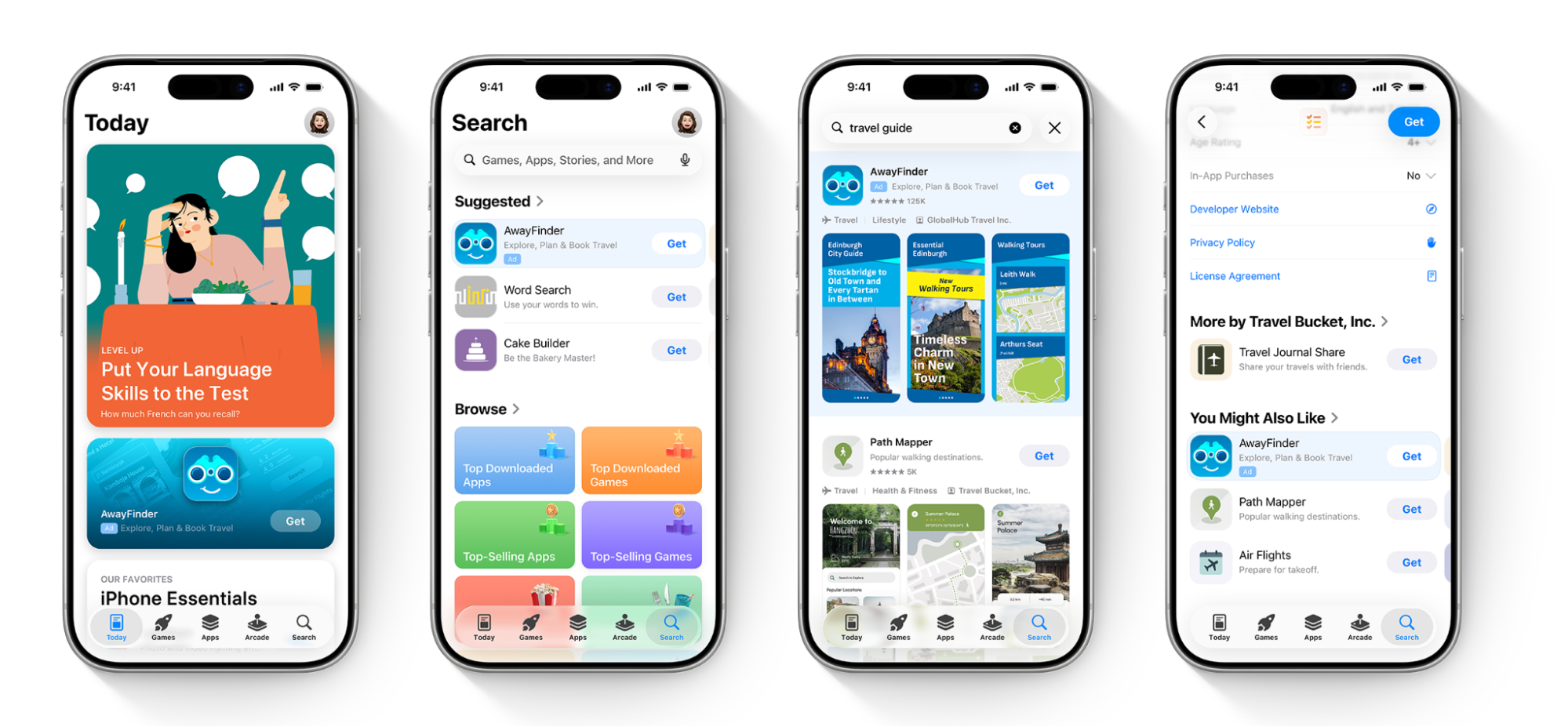
Apple Ads Advanced offers four App Store ad placements: Today tab, Search tab, search results, and product pages. Each placement reaches people at a different moment in their App Store journey, so they should not all be planned, measured, or optimized in the same way.
A useful way to think about placements is to ask what the person is doing when the ad appears. Are they starting their App Store visit, browsing before a specific search, actively searching for an app, or reviewing app product pages before deciding what to download? That context should guide the campaign goal, budget, bidding approach, creative assets, and performance expectations.
For a deeper look at how these placements can work together, see our article on building a 2026 multi-placement ad strategy.
Search results ads
Search results ads help people discover your app when they are searching on the App Store. When someone enters a search query, your ad can appear in search results if it is relevant to that search and eligible based on your campaign setup.
This placement is especially useful when you want to reach people who are already expressing intent through a search. In search results campaigns, advertisers can use keywords, bids, budgets, audience settings, and ad variations to manage how their ads reach relevant searches.
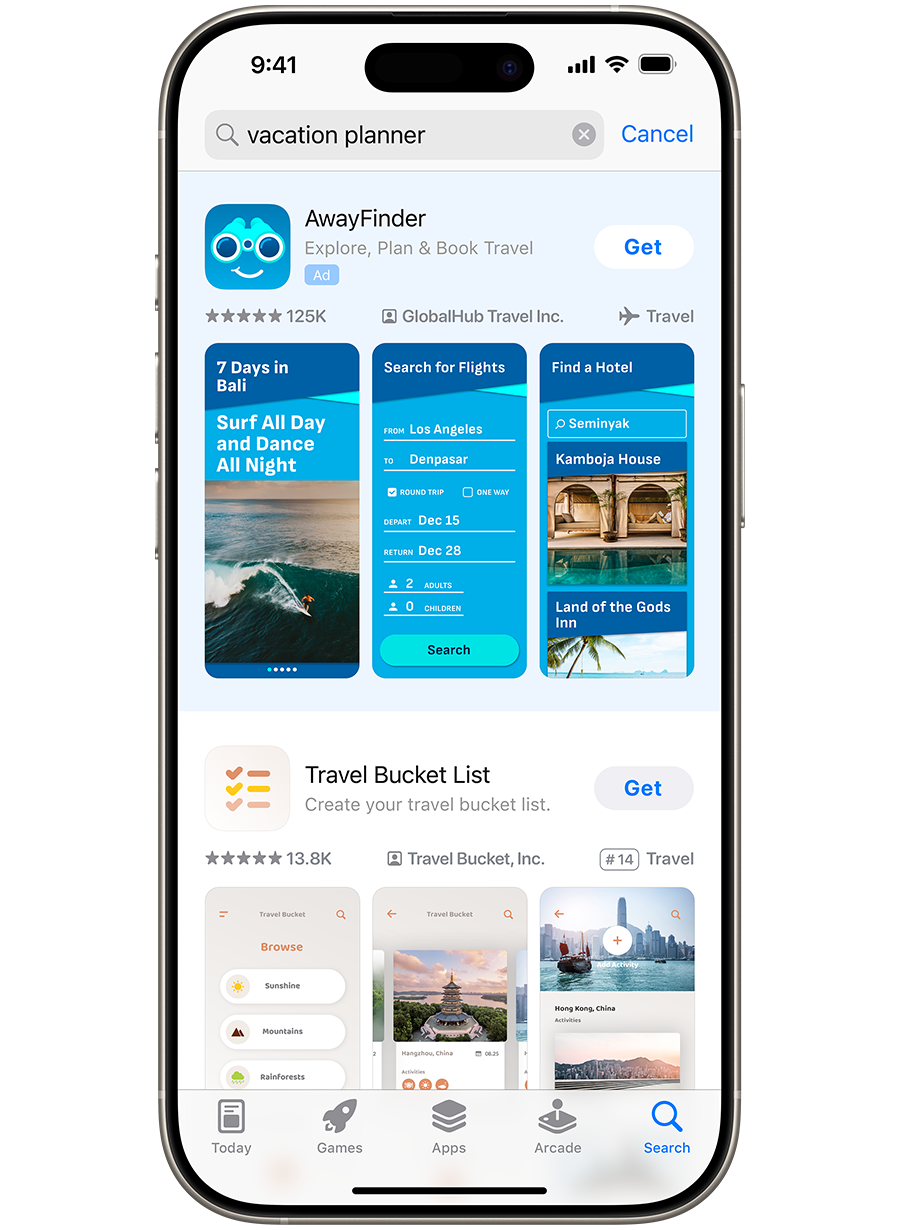
Search results campaigns can be useful for:
- Reaching people at the moment they search for apps to download;
- Testing which relevant search terms drive taps and downloads;
- Organizing campaigns around different keyword themes;
- Using ad variations to align creative with specific keyword themes or audiences;
- Connecting paid search learnings with App Store optimization decisions.
Search results ads may appear at the top of search results or further down the page. Advertisers can’t select or bid for a specific ad position, so performance should be monitored by campaign, ad group, keyword, search term, and ad variation rather than by position alone. For a deeper look at what expanded search results inventory means for campaign planning in 2026, read our article on Apple Ads expanded search results inventory.
Search tab ads
Search tab ads help you reach people before they search for something specific. These ads appear at the top of the suggested apps list on the Search tab.
Apple Ads notes that over 70% of App Store visitors use search to discover apps, which makes the Search tab useful for reaching users just before they search.¹
This placement is useful when you want to reach people earlier in the discovery process, before they enter a query. Unlike search results campaigns, Search tab campaigns are not built around keyword targeting. They should be planned with broader discovery goals and measured with the understanding that the user has not yet expressed a specific search intent.
¹ Source: Apple Ads, App Store
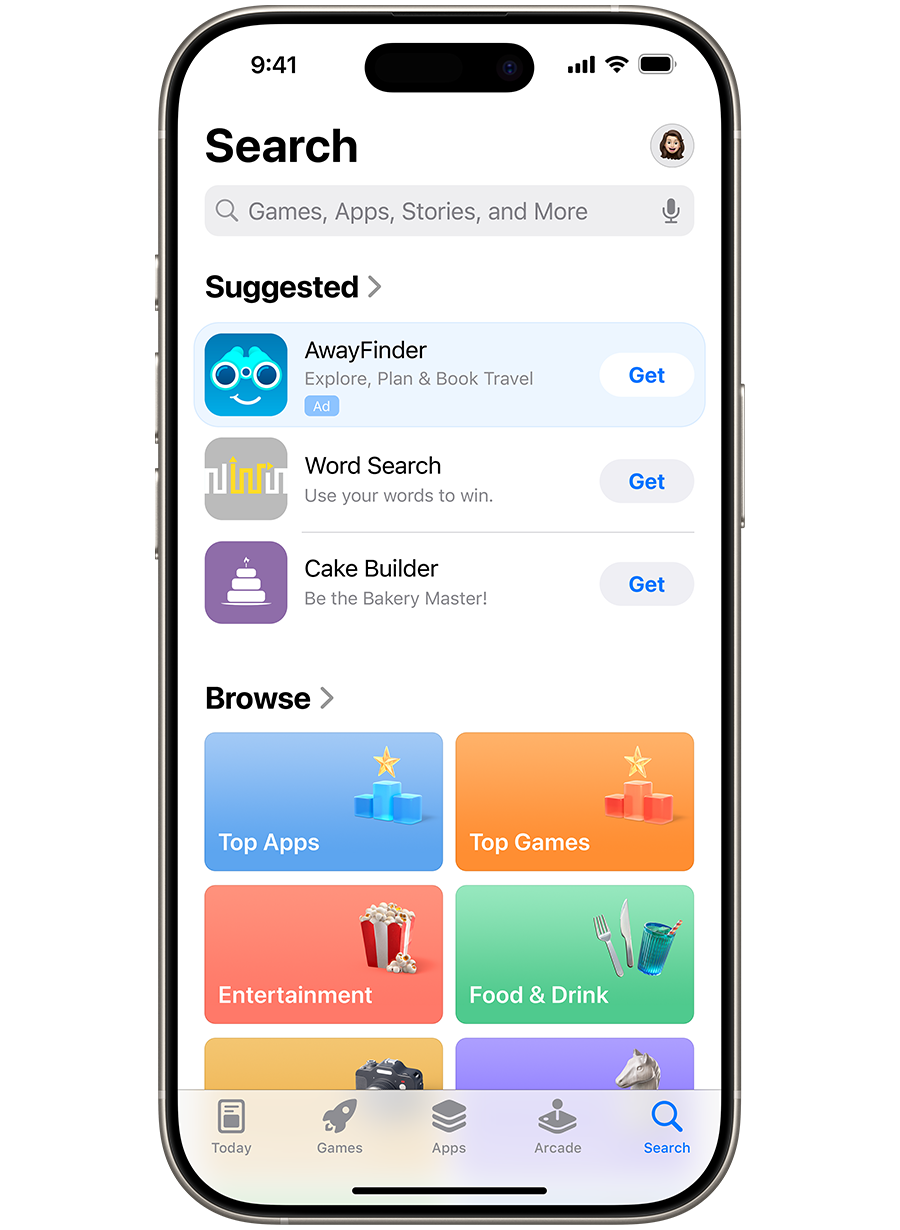
Search tab ads can be useful when you want to:
- Reach people before they search for something specific;
- Increase visibility in the Search tab;
- Support discovery for your app or category;
- Use your default product page or a custom product page as the tap destination;
- Test whether broader App Store discovery can support your acquisition goals.
Because Search tab ads reach people earlier than search results ads, evaluate performance with the right expectation. Tap volume alone is not enough; review conversion rate, CPA, and downstream quality before increasing spend.
Today tab ads
Today tab ads help you reach people on the front page of the App Store, where users start their visit. These ads are designed for high-visibility discovery moments and use assets from a custom product page set up in App Store Connect.
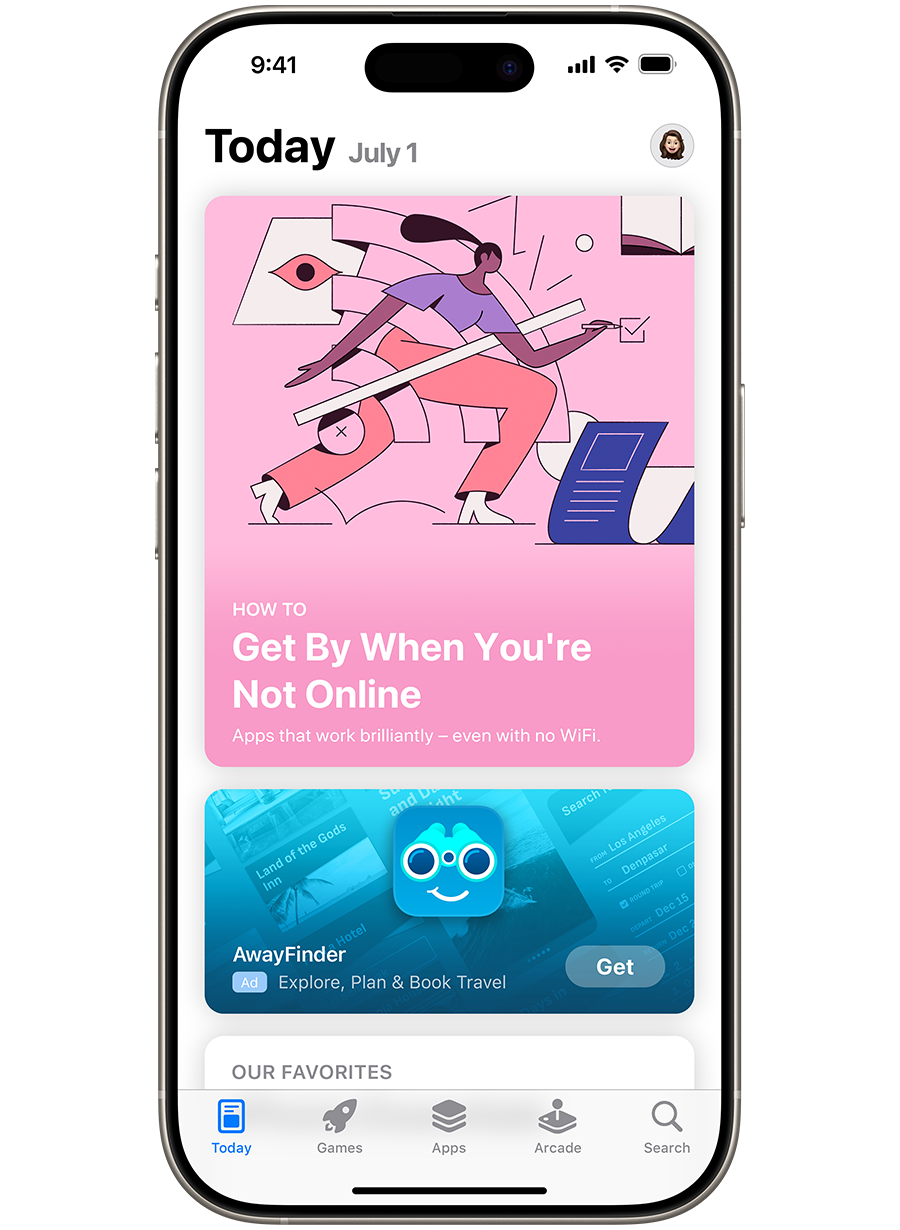
Today tab can be useful when you want to promote an app launch, major update, seasonal campaign, event, or other timely message. Since the ad experience is closely tied to the selected custom product page, the message and creative assets should be clear, relevant, and ready for review.
Today tab ads can be useful for:
- Reaching people as they start their App Store visit;
- Supporting app launches, updates, seasonal moments, or major campaigns;
- Using custom product page assets as part of the ad experience;
- Sending people to a custom product page as the tap destination;
- Using deep links on supported iOS and iPadOS versions when relevant.
Today tab should not be treated the same way as search results. The user has not entered a search query, so the role of the placement is broader discovery rather than direct search-intent capture.
Product pages ads
Product pages ads help you promote your app to people while they are browsing app product pages across the App Store. Ads can appear at the top of the You Might Also Like list after users scroll to the bottom of product pages.
This placement reaches people who are actively researching apps and reviewing information that may help them decide what to download. You can run ads across app categories or refine the categories where your ads run.
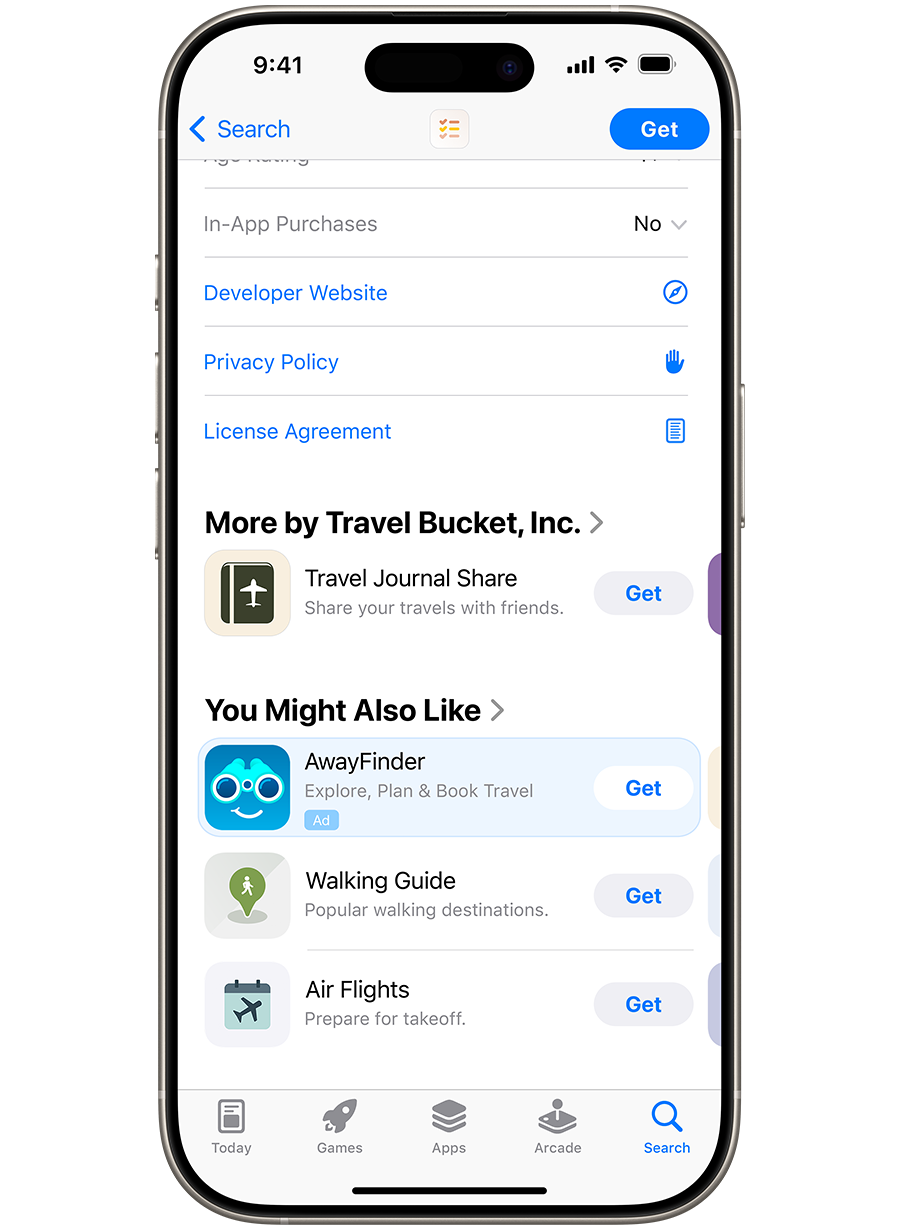
Product pages ads can be useful when you want to:
- Reach people while they browse app product pages;
- Promote your app to users researching related apps or categories;
- Expand reach beyond search-driven campaigns;
- Use category refinement to keep the placement more relevant;
- Evaluate consideration-stage traffic separately from search results traffic.
Product pages should not be treated as extra search traffic. The user context is different, so performance should be reviewed separately with attention to conversion rate, CPA, and post-install quality.
Apple Ads Basic vs Apple Ads Advanced
Apple Ads offers two solutions for promoting apps on the App Store: Apple Ads Basic and Apple Ads Advanced. The right choice depends on your app marketing experience, available resources, budget, and how much control you need over campaign setup, bidding, reporting, and optimization.
For a deeper comparison of the two solutions, you can read our guide: Apple Ads Basic vs Advanced: Which Solution Is Right for Your App?
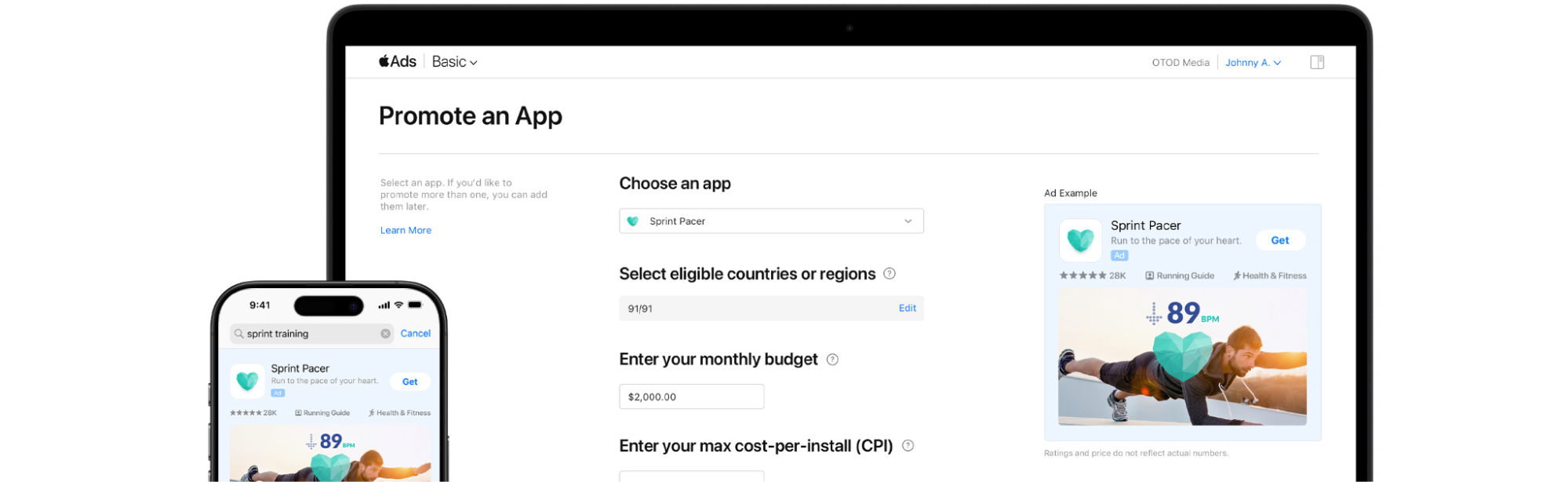
Apple Ads Basic is designed for developers who want a simpler way to promote an app in App Store search results. You choose the app, select the countries and regions where you want to promote it, set a monthly budget, and choose the maximum cost-per-install you are willing to pay. Apple’s intelligent automation then matches your ad to interested users and works to maximize installs within your budget and max CPI.
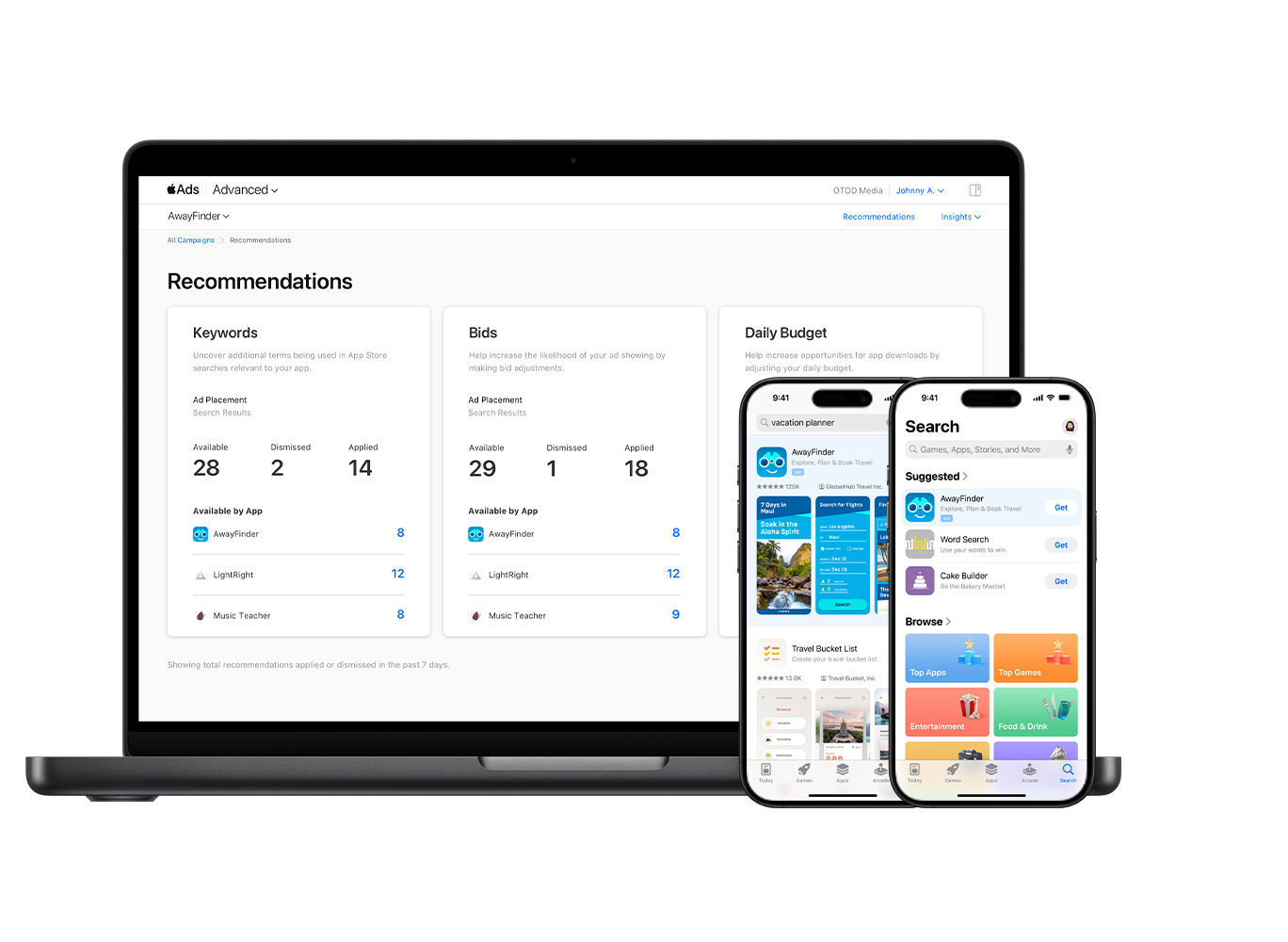
Apple Ads Advanced gives developers, advertisers, and agencies more tools to manage campaigns across the App Store. With Advanced, you can run ads on the Today tab, Search tab, in search results, and across product pages while users are browsing. You can choose keywords for Manage Bids search results campaigns, use an auto-bidder with Maximize Conversions search results campaigns, align ads with custom product pages, set the maximum amount you want to pay for a tap, and control spend at the campaign level with a daily budget.
| Area | Apple Ads Basic | Apple Ads Advanced |
| Best for | Developers who want a simpler setup | Developers, advertisers, or agencies that need more campaign control |
| Ad placement | App Store search results | Today tab, Search tab, search results, and product pages |
| Setup | Choose your app, countries or regions, monthly budget, and max CPI | Create campaigns with placement, budget, bidding, keyword, audience, and creative options |
| Keywords and audience settings | No keywords or audience settings | Keyword selection for Manage Bids search results campaigns; Search Match is used with Maximize Conversions |
| Pricing model | Cost-per-install | Cost-per-tap |
| Budget | Monthly budget, up to $10,000 U.S. per app, per month | Campaign-level daily budget with no monthly budget maximum |
| Reporting | Quick-view dashboard | Detailed reports and insights for key metrics across the account |
| APIs | Access to the AdServices Attribution API; no keyword data or Apple Ads Campaign Management API access | AdServices Attribution API and Apple Ads Campaign Management API access |
How to set up your first Apple Ads campaign
Your first Apple Ads campaign should be simple enough to manage, measure, and improve. For many advertisers, a search results campaign in Apple Ads Advanced is the easiest place to start because it connects your app with people actively searching on the App Store.
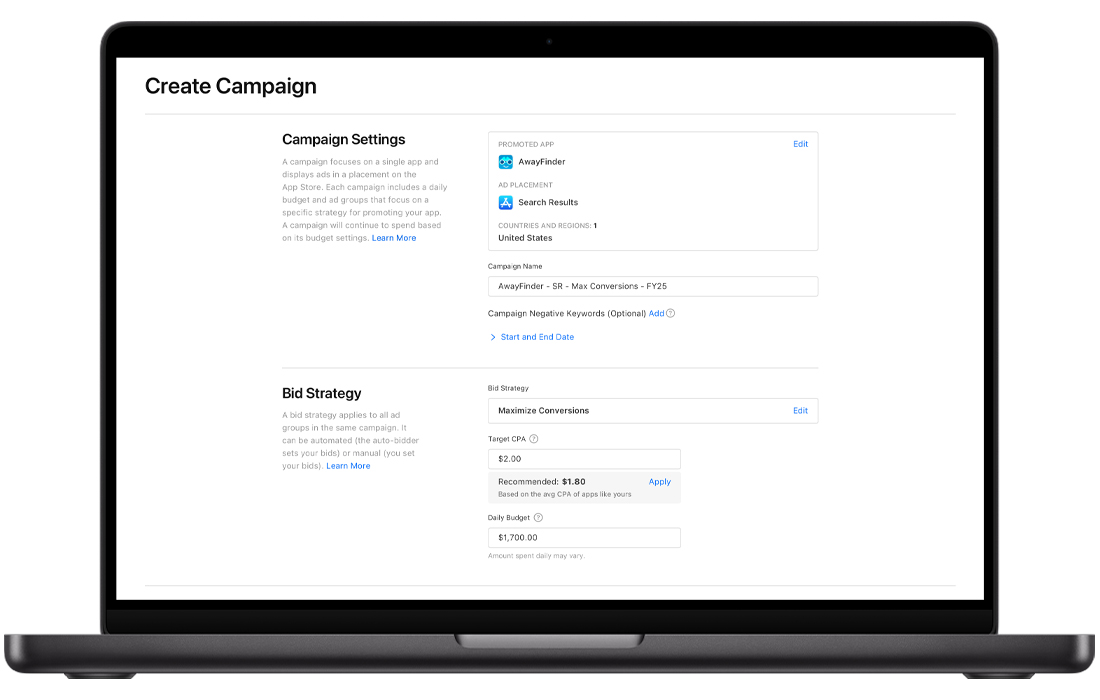
For a first setup, keep the campaign focused on one priority country or region, one clear goal, and a small set of relevant keywords. This makes early performance easier to read.
| Step | What to do | Why it matters |
| 1 | Choose Apple Ads Advanced and select the app you want to promote | Connects your campaign to the app and gives you access to campaign setup, reporting, and optimization tools |
| 2 | Choose search results as the placement | Lets your ad appear in relevant App Store search results |
| 3 | Select your country or region and set a daily budget | Keeps spend and reporting easier to control |
| 4 | Create an ad group around one keyword theme | Helps you separate different types of search intent |
| 5 | Set your default max CPT bid | Defines the maximum amount you are willing to pay for a tap, unless you set keyword-level bids |
| 6 | Add keywords and choose match types | Exact match gives more control; broad match can help you reach related searches |
| 7 | Add negative keywords and review before launch | Helps prevent your ad from showing for irrelevant searches |
A simple first campaign might include separate ad groups for brand terms, category terms, and discovery terms. For example, a fitness app could separate searches for the app name, searches like “workout planner” or “fitness tracker,” and broader discovery terms used to find new opportunities.
Once this first structure is clear, MobileAction CMP can help turn the same setup into a managed workflow for creating campaigns, ad groups, keywords, ads, custom product pages, and negative keywords from one place.
After launch, avoid making major changes too quickly. First, check whether the campaign is getting impressions, whether people are tapping the ad, and whether those taps are turning into downloads.
| Signal | What it may mean | What to review |
| Low impressions | Keywords may be too narrow, bids may be too low, or relevance may be limited | Keyword coverage, bids, and app relevance |
| High impressions but low TTR | The ad may not match the search intent closely enough | Keywords, match types, ad group structure, and ad variations |
| Taps but few downloads | The product page may not match what users expected | Screenshots, messaging, ratings, reviews, and custom product page alignment |
Search term review is especially useful when you use broad match or Search Match. If a search term is relevant and performs well, you can add it as a keyword. If it is irrelevant or inefficient, you can add it as a negative keyword.
Apple Ads keyword strategy
Apple Ads keyword strategy is the process of choosing, organizing, and managing keywords for search results campaigns. Keywords help Apple Ads understand which App Store searches your ad may be relevant for, and they work together with match types, Search Match, bids, negative keywords, and campaign structure.
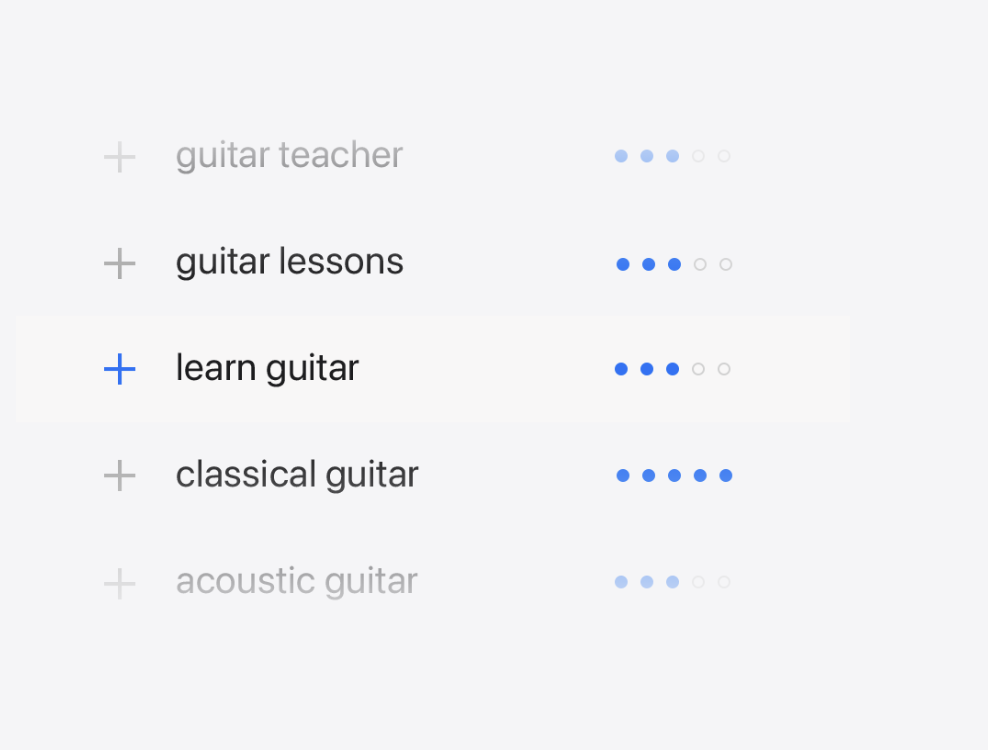
A strong keyword strategy should help you answer a few practical questions:
- Which search terms are most relevant to your app?
- Which keywords should be managed with exact match?
- Which keywords should use broad match to help discover related searches?
- Which terms should be added as negative keywords?
- Which search terms should inform future campaign, ad variation, or product page decisions?
For teams building keyword lists at scale, MobileAction CMP’s AI Keyword Planner can turn keyword research into a more connected Apple Ads workflow. Teams can start with their app or a seed keyword, then review recommendations shaped around their market and app context.
Each recommendation can be evaluated with signals such as organic ranking, search volume, difficulty, paid activity, and ranked apps, so keyword decisions are not based on volume alone. From the same workflow, teams can save promising terms, add selected keywords to relevant ad groups, or set irrelevant terms as negative keywords without switching tabs. This is especially useful when discovery campaigns, broad match, or Search Match produce a large set of search terms that need to be prioritized, grouped, and acted on.
Exact match
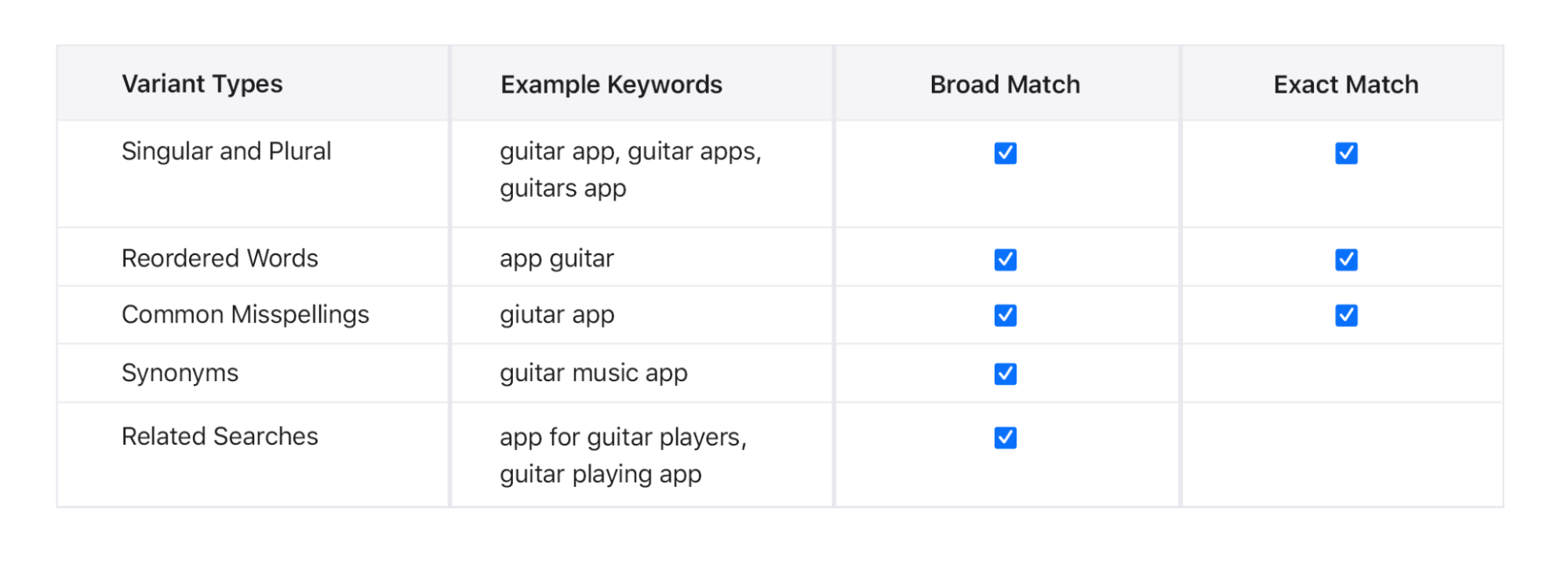
An exact match gives you tighter control over the types of searches where your ad may appear. It is designed to match queries to the specific term you select and closer variants, such as spelling variations, word rearrangements, translations, and other variants Apple Ads systems consider close.
An exact match can be useful when you want to manage important keywords more closely, such as:
- Your app name or company name;
- Category terms that clearly describe what your app does;
- Specific feature or use-case terms;
- Selected competitor or related app terms;
- Search terms that have already shown useful performance.
For example, a budgeting app might use an exact match for terms such as:
| Keyword | Why exact match may be useful |
| “budget planner” | Closely related to the app category |
| “expense tracker” | Describes a specific feature or use case |
| “monthly budget app” | Reflects a more specific search need |
| App or brand name | Helps reach people searching directly for the app or company |
An exact match may result in fewer impressions than a broad match, but it can help you focus on searches that are closer to the keyword you selected. Apple Ads recommends using exact match for brand, category, and competitor campaign types when creating a search results campaign structure.
Broad match
Broad match can help your ad appear for a wider range of searches related to your keyword. It can include relevant close variants, such as singulars, plurals, misspellings, synonyms, related searches, and phrases that include the term fully or partially.
Broad match can be useful when you want to:
- Expand coverage beyond a fixed keyword list;
- Discover related search terms;
- Capture search trends or lower-volume terms;
- Understand how people search for apps like yours;
- Support a discovery campaign.
For example, a meditation app using broad match for “sleep meditation” may match to related searches that are not already in the exact keyword list. Some of those terms may later be useful to add as exact match keywords if they perform well.
Broad match should be reviewed regularly through search term performance. Apple Ads recommends using broad match in discovery campaigns and adding performing search terms to the appropriate brand, category, or competitor campaigns as exact match keywords.
Search Match
Search Match can automatically match your ad to relevant App Store searches without requiring you to add every keyword manually. It uses multiple resources to match ads to relevant searches, including metadata from your App Store product page, information about similar apps in the same genre, and other search data.
Search Match is a default feature for Manage Bids search results campaigns, and it is required for the automatic ad group in Maximize Conversions search results campaigns.
Search Match can be useful when you want to:
- Discover additional relevant search terms;
- Get a campaign running without building a full keyword list first;
- Learn how people search for apps like yours;
- Support discovery in new markets or languages;
- Identify search terms that may be added later as keywords.
If you use Search Match, review search terms regularly. When you find search terms that perform well, you can add them as keywords in the relevant campaign or ad group. If certain terms do not apply to your app or do not support performance, you can add them as negative keywords.
Negative keywords
Negative keywords help prevent your search results ads from appearing for certain searches. They can help control costs and improve campaign efficiency by excluding terms that do not apply to your app or that are not leading to conversions.
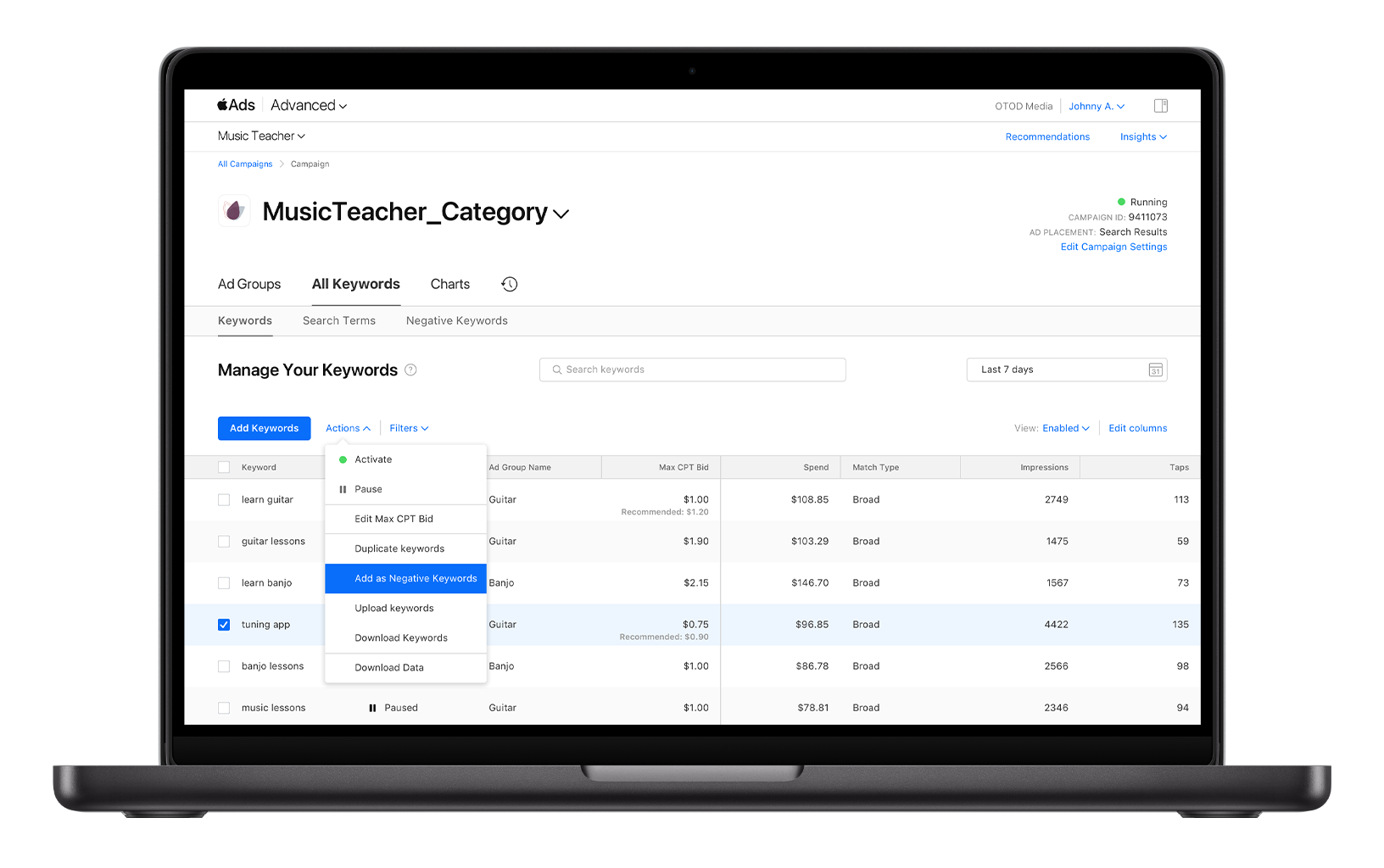
Negative keywords may be useful when:
- A search term does not describe what your app offers;
- A term receives taps but does not lead to downloads;
- A keyword belongs in a different campaign or ad group;
- You want to keep discovery traffic from overlapping with exact match campaigns;
- A broad match or Search Match campaign starts matching to searches that are not relevant.
The default setting for negative keywords is exact match. Exact match negative keywords block your ad from matching to the exact term you specify. Broad match negative keywords can be used when you want to block words or phrases more broadly, no matter what order the words appear in.
Common keyword mistakes to avoid
Avoid treating all keywords the same. A brand term, category term, broad match keyword, and Search Match result may each need a different bid, budget, review process, and expectation.
Common mistakes include:
- Adding unrelated keywords to the same ad group;
- Using only broad match without reviewing search terms;
- Leaving Search Match on without checking matched search terms;
- Forgetting to add negative keywords when terms do not apply to your app;
- Changing bids without checking conversion rate and CPA;
- Using discovery campaigns without moving useful terms into exact match;
- Mixing brand, category, competitor, and discovery terms in a way that makes reporting harder to read;
- Creating ad variations without a clear keyword theme or audience reason.
A good Apple Ads keyword strategy is not just a list of keywords. It is a repeatable process: choose relevant keywords, use match types intentionally, review search terms, add negative keywords, adjust bids, and use what you learn to improve campaign structure and ad relevance.
Apple Ads bidding and budget strategy
Apple Ads bidding and budget strategy helps you control how much you are willing to pay, how your campaign spend is managed, and how you evaluate performance after launch.
In Apple Ads Advanced, search results campaigns can use one of two bid strategies: Manage Bids or Maximize Conversions. Manage Bids gives you more manual control over keyword selection and max CPT bids. Maximize Conversions uses Apple Ads automation to help get the most tap-through installs at a target CPA you set.
Your daily budget is the average amount you want to spend each day over the course of a month. Spend may be higher on some days when there are more opportunities, but monthly spend is calculated based on your daily budget and the average number of days in a calendar month. For 2026 planning, avoid building new guidance around lifetime budgets, since Apple has moved campaign budgeting guidance toward daily budgets.
Manage Bids
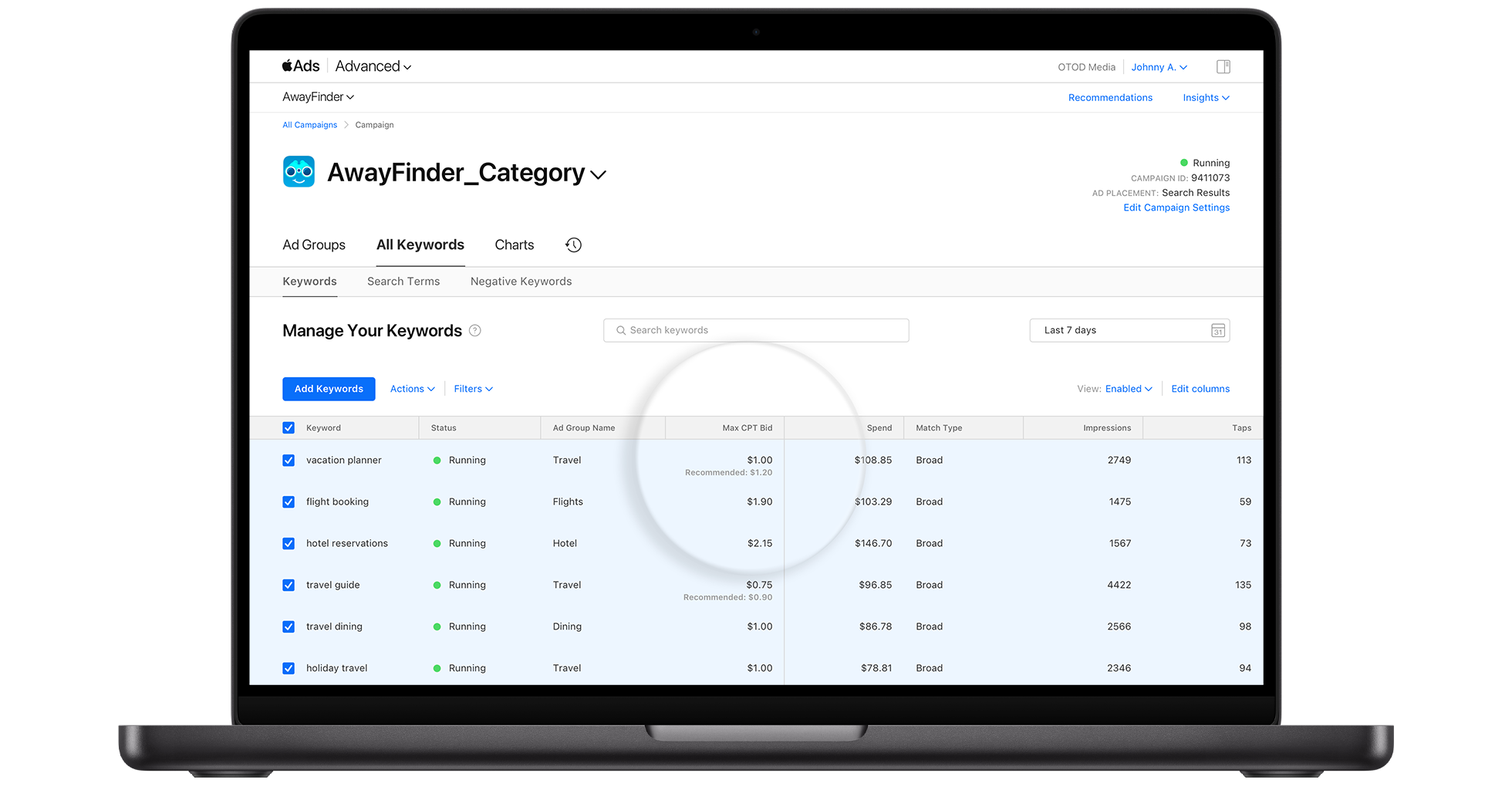
Manage Bids is a bid strategy for search results campaigns that lets you manually choose keywords, use match types, set max CPT bids, and manage bids at the ad group or keyword level.
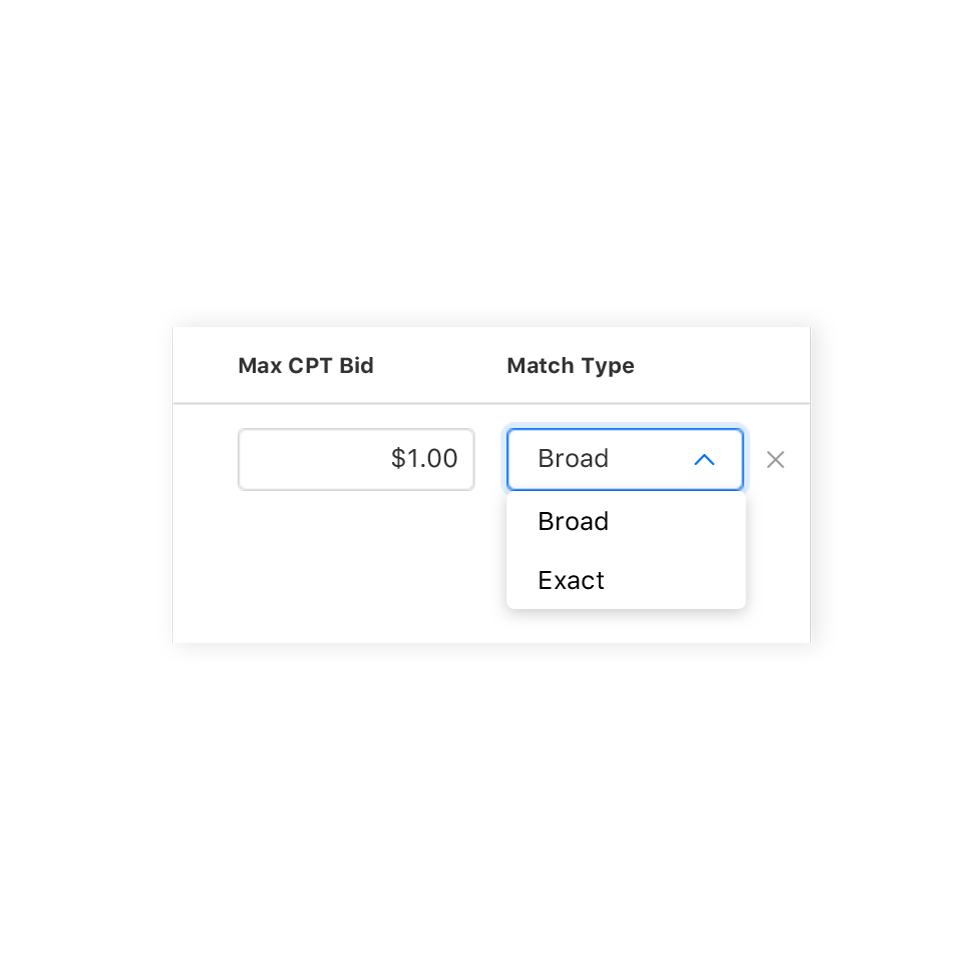
With Manage Bids, you set a maximum cost-per-tap bid, also called a max CPT bid. This is the maximum amount you are willing to pay for a tap on your ad. A default max CPT bid is set at the ad group level, but you can also set different max CPT bids for individual keywords.
Manage Bids can be useful when you want to:
- Control keyword-level bidding manually;
- Organize bids by keyword theme, campaign type, or ad group;
- Use exact match, broad match, Search Match, and negative keywords;
- Review search term performance and add relevant terms as keywords;
- Adjust bids based on impressions, taps, downloads, average CPT, conversion rate, and CPA.
Apple Ads may provide max CPT bid suggestions, bid insights, and customized recommendations for keywords, bids, target CPA, and daily budgets. These recommendations can help inform optimization decisions, but they should be treated as decision inputs rather than performance guarantees. Before applying changes at scale, review them together with your own campaign data, including conversion rate, average CPA, spend, budget pacing, and post-install quality where available.
As campaign load grows, manually managing bid and budget changes across campaigns, ad groups, keywords, storefronts, and campaign groups can become harder to control. MobileAction CMP’s smart tools can help teams manage this workflow productively.
AI Smart Bidding can support bid decisions across campaign portfolios and countries while keeping optimization aligned with goals such as CPA, ROAS, or custom performance targets. Budget Allocation can distribute budget across selected campaigns based on performance, while budget scheduler can apply different daily budgets for specific days or date ranges, such as weekends, holidays, seasonal pushes, or launch periods. This helps teams spend less time repeating manual bid and budget changes and more time reviewing structure, search term quality, negatives, creatives, and performance trends.
For 2026 planning, avoid building your bidding and budget strategy around CPA caps or lifetime budgets. Apple Ads is moving search results campaign management toward a cleaner daily budget and target CPA model, especially with Maximize Conversions. In this setup, daily budget controls overall spend, while target CPA represents the average amount you want to spend per install. Target CPA is not a hard ceiling. Actual CPA may go above or below the target on a given day, while Apple Ads aims to meet the target on average over time.
This shift also changes how advertisers should think about scale. Instead of using a strict CPA cap that can limit impressions and install opportunities, Maximize Conversions gives Apple Ads more flexibility to bid differently across search queries while still optimizing toward the target CPA on average. For a deeper breakdown, see Apple’s Maximize Conversions best practices and article about Maximize Conversions bidding for search results campaigns.
Maximize Conversions campaigns
Maximize Conversions is designed for search results campaigns where you want Apple Ads automation to help drive tap-through installs at a target CPA. It uses an auto-bidder and Search Match to set bids and prioritize keywords that are more likely to lead to installs.
For a more detailed breakdown of target CPA, Search Match, daily budget, and campaign setup, read our article on Maximize Conversions bidding for search results campaigns.
This strategy can be useful when you want to simplify campaign management and broaden reach, especially after a campaign has enough post-launch context to optimize from. If you need tighter manual control over keywords, match types, and keyword-level bids, Manage Bids is usually the better fit.
Custom product pages and ad variations
Custom product pages let you create additional versions of your App Store product page for different audiences, features, content, or seasonal moments. Each page can use different screenshots, app previews, promotional text, and, where supported, a deep link to a specific place in your app.
In Apple Ads, custom product pages can be used to create more relevant ad experiences. For search results ads, advertisers can create ad variations from custom product pages set up in App Store Connect. This helps align ad creative with specific audiences or keyword themes without changing the app’s default product page.
For more context on how creative assets, App Store Connect updates, custom product pages, and deep-linked journeys are evolving, see our breakdown of the WWDC 2026 App Store updates.
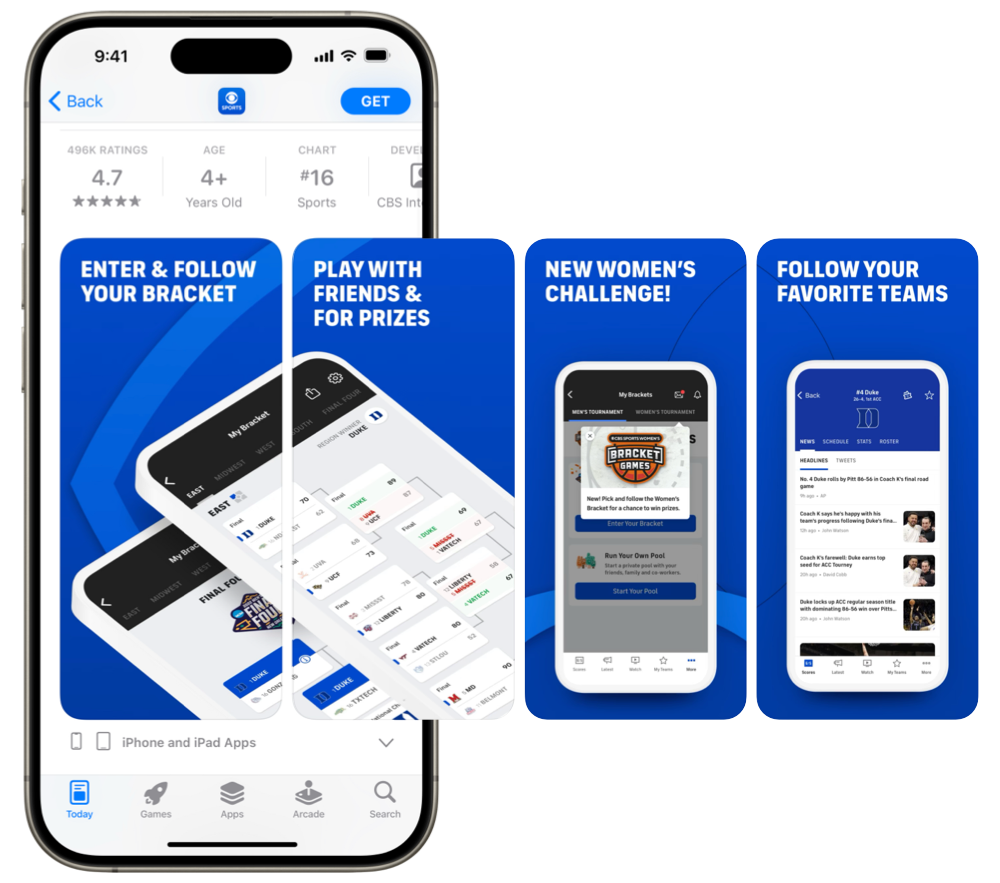
Custom product pages can be useful when your campaign message needs a more specific App Store experience. For example, an app may use one page to highlight a new feature, another for a seasonal campaign, and another for a specific audience or market. The goal is not to create a separate page for every keyword, but to use custom product pages when different screenshots, app previews, or promotional text can make the experience clearer.
When reviewing performance, look at whether the custom product page or ad variation supports the campaign goal. Useful metrics include impressions, taps, TTR, average CPT, installs, conversion rate, and CPA. If an ad variation receives taps but few installs, review whether the page matches the audience, keyword theme, or campaign message.
When custom product pages are used for different keyword themes or audiences, MobileAction CMP’s CPP A/B Testing can help compare variants across Apple Ads ad groups with less manual setup and clearer monitoring.
Apple Ads metrics and reporting
Apple Ads reporting helps you understand how your campaigns are performing across placements, campaigns, ad groups, ads, keywords, search terms, and countries or regions. The goal is to see whether your ads are being shown, whether people are tapping them, and whether those taps are leading to installs.
The most important Apple Ads metrics include impressions, taps, TTR, average CPT, installs, CR, average CPA, and spend.
For a deeper look at recent measurement changes, read our guide to the Apple Ads Insights and App Store Connect Analytics updates.
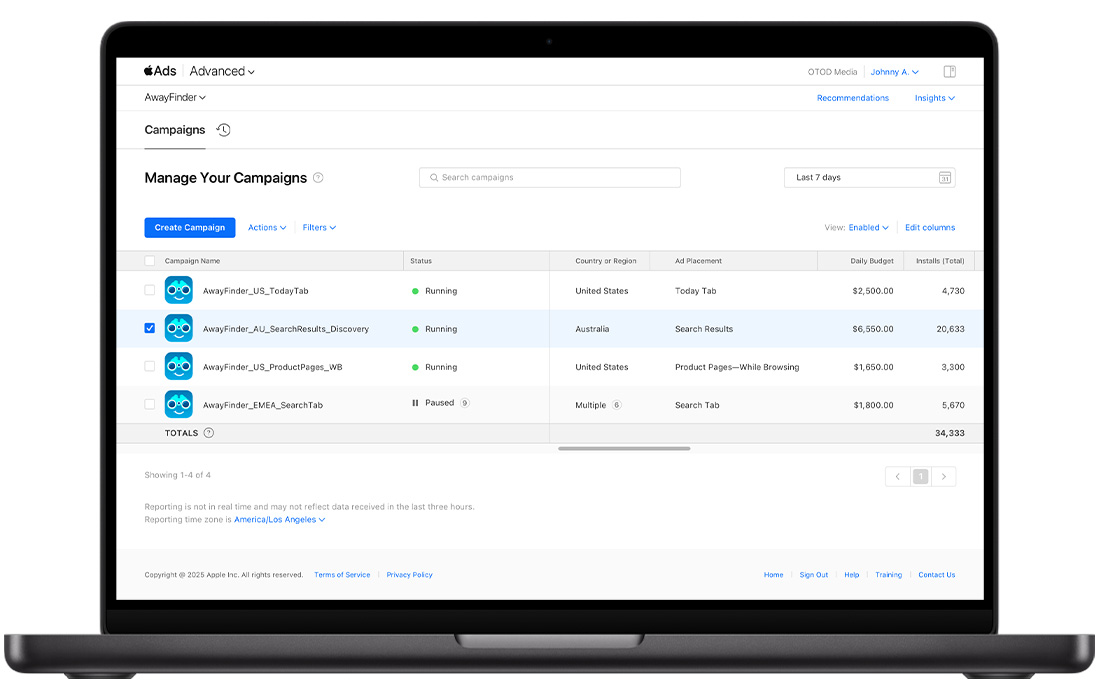
| Metric | What it tells you |
| Impressions | How many times your ad appeared on the App Store |
| Taps | How many times people tapped your ad |
| TTR | How often impressions became taps |
| Average CPT | The average amount paid for a tap |
| Installs | Downloads attributed to your ad |
| CR | How often taps became installs |
| Average CPA | Average cost for an attributed install |
| Spend | How much the campaign spent in the selected period |
These metrics should be reviewed together, not separately. For example, a campaign with many impressions but low TTR may need a closer look at relevance, placement, or ad creative. A campaign with taps but low CR may need closer review of the product page, the custom product page, or an ad variation.
Reporting should also match the campaign type. Search results campaigns may require keyword and search term review, while Search tab, Today tab, and product pages campaigns should be evaluated with their placement context in mind. Comparing placements without considering where the user sees the ad can lead to the wrong conclusion.
A simple reporting routine is to check what changed, identify where it changed, and decide what action to take. Depending on the signal, that may mean adjusting bids, reviewing search terms, adding negative keywords, changing budgets, testing ad variations, or improving the product page experience.
For deeper measurement, Apple Ads can also work with attribution solutions such as the AdServices attribution API and mobile measurement providers. This is useful when teams need to connect Apple Ads campaign data with broader attribution or post-install measurement.
Apple Ads automation and AI
Automation in Apple Ads should be understood in two layers: Apple Ads’ native automation features and the additional workflow automation teams can build around campaign management, bidding, budgeting, keyword research, and reporting.
On the Apple Ads side, Maximize Conversions is the clearest example of native bidding automation for search results campaigns. Instead of manually setting max CPT bids for individual keywords, advertisers set a daily budget and target CPA. Apple Ads then uses an auto-bidder to calculate bids for each search query, with the goal of maximizing tap-through installs at the target CPA on average over time. This can reduce manual bid work, but it still needs a clear budget, realistic CPA target, and regular performance review.
Apple Ads also supports automation through Search Match and recommendations. Search Match can automatically match ads to relevant App Store searches without requiring advertisers to build every possible keyword manually. It can support discovery in Manage Bids campaigns and is also part of Maximize Conversions automatic ad groups. Apple Ads recommendations can surface keyword, bid, target CPA, and daily budget opportunities, helping advertisers identify where changes may improve performance. These recommendations should be reviewed as decision inputs, not treated as guaranteed outcomes.
Keyword discovery should not depend only on Maximize Conversions. Teams can use Search Match, broad match, search term reviews, keyword recommendations, and external keyword intelligence together to find new opportunities. The important step is turning discovery into action: promote strong search terms into the right campaigns, add irrelevant terms as negatives, and connect keyword learnings with ad variations, custom product pages, and ASO decisions.
For larger Apple Ads accounts, automation also becomes a workflow question. Managing bids, budgets, keywords, negatives, campaign pacing, and performance checks across many campaigns and storefronts can become difficult if every action is handled manually.
MobileAction CMP can support this layer with AI Smart Bidding, AI Keyword Planner, Budget Allocation, and Budget Scheduler.
- AI Smart Bidding can help teams manage bid changes around goals such as target CPA, CPI, ROAS, or impression share.
- AI Keyword Planner can help discover and evaluate keyword opportunities by app or seed keyword.
- MobileAction’s AI Assistant can help teams analyze campaign data in plain language, create views dynamically, and keep follow-up questions connected to the same performance flow.
- AI Benchmarks can help teams understand how key metrics such as CR, TTR, CPT, and CPA are moving, making it easier to spot performance shifts and decide where optimization is needed.
Apple Ads best practices for 2026
Apple Ads best practices in 2026 are about building a clear, repeatable workflow: structure campaigns by intent, use the right placement for the right goal, manage keywords carefully, align ad creative with user intent, and measure performance beyond surface-level metrics.
Use these practical rules to manage Apple Ads more productively.
1. Structure campaigns by keyword theme
A strong Apple Ads account starts with a clean campaign structure. Instead of grouping every keyword into one campaign, separate campaigns by keyword theme so performance is easier to read and optimize.
A practical structure includes:
| Campaign type | Main purpose |
| Brand | Reach users searching for your app or company name |
| Category | Reach users searching for apps like yours |
| Competitor | Reach users searching for similar apps |
| Discovery | Find new relevant search terms through broad match and Search Match |
For brand, category, and competitor campaigns, use exact match for more control. Use discovery campaigns to identify new search terms that may later be added to your core campaigns.
2. Use Search results for high-intent demand
Search results ads help you reach users when they are actively searching for apps to download. Because the user’s search query is a direct signal of intent, this placement is especially useful for performance-focused campaigns.
In 2026, search results ads can appear at the top of search results or further down the page. That creates more opportunities to reach users, but it also makes performance monitoring more important. Watch spend, conversion rate, CPA, and search term quality closely instead of assuming more traffic is always better.
3. Use other placements with clear expectations
Apple Ads also lets you run ads in multiple places. These placements support different moments in the App Store journey.
The Search tab can help you reach users before they search for something specific. The Today tab can provide broader visibility when users first arrive on the App Store. Product pages, while browsing, can help you reach users while they are actively researching apps.
Do not judge every placement by the same standard. A search results campaign and a Today tab campaign may play different roles, so review performance based on the goal of each placement.
When performance differs by country, category, or placement, MobileAction CMP’s Benchmarks can help compare results against broader Apple Ads market standards before deciding where to adjust bids, budgets, or creative tests.
4. Use exact match, broad match, and Search Match for different jobs
Exact match, broad match, and Search Match should not be used in the same way.
Use exact match when you want tighter control over important keywords. Use broad match when you want to reach related searches and discover new keyword opportunities. Use Search Match when you want Apple Ads to automatically match your ad to relevant App Store searches based on your app, metadata, similar apps, and other search data.
A simple workflow is:
- Use broad match and Search Match for discovery.
- Review search term performance.
- Move strong terms into exact match campaigns.
- Add irrelevant or inefficient terms as negative keywords.
- Adjust bids based on performance.
5. Review search terms regularly
Search term reviews help you understand what users actually searched before seeing, tapping, or downloading from your ad.
Look for terms that deserve higher bids, terms that should be added as exact match keywords, and terms that should be excluded with negative keywords. Also watch for new keyword themes that may support future Custom Product Pages, screenshot messaging, or ASO decisions.
If discovery campaigns are not reviewed regularly, they can become harder to control.
6. Use negative keywords to protect budget
Negative keywords help prevent search results ads from appearing for searches that are not relevant to your app. They are especially useful in discovery campaigns, broad match campaigns, and accounts with overlapping keyword themes.
Use negative keywords to reduce irrelevant traffic, separate discovery from exact match campaigns, and prevent budget from going to terms that do not support your goals. For example, when a discovery campaign finds a strong search term, you can move that term into the right brand, category, or competitor campaign, then add it as an exact match negative in the discovery campaign to avoid overlap. If a search term is irrelevant or spends without converting, you can add it as a negative keyword to stop future waste.
As accounts scale, negative keyword management becomes more than a one-time cleanup task. In MobileAction CMP, teams can manage negative keywords from Ads Manager and apply them at the campaign or ad group level depending on how broadly the exclusion should work. Campaign-level negatives can help protect an entire campaign, while ad group-level negatives can keep exclusions more specific to one keyword theme or audience.
MobileAction Automations can also help turn repeated search term cleanup into a rule-based workflow. For example, teams can create automations that add inefficient search terms or keywords as negative keywords based on Apple Ads performance signals.
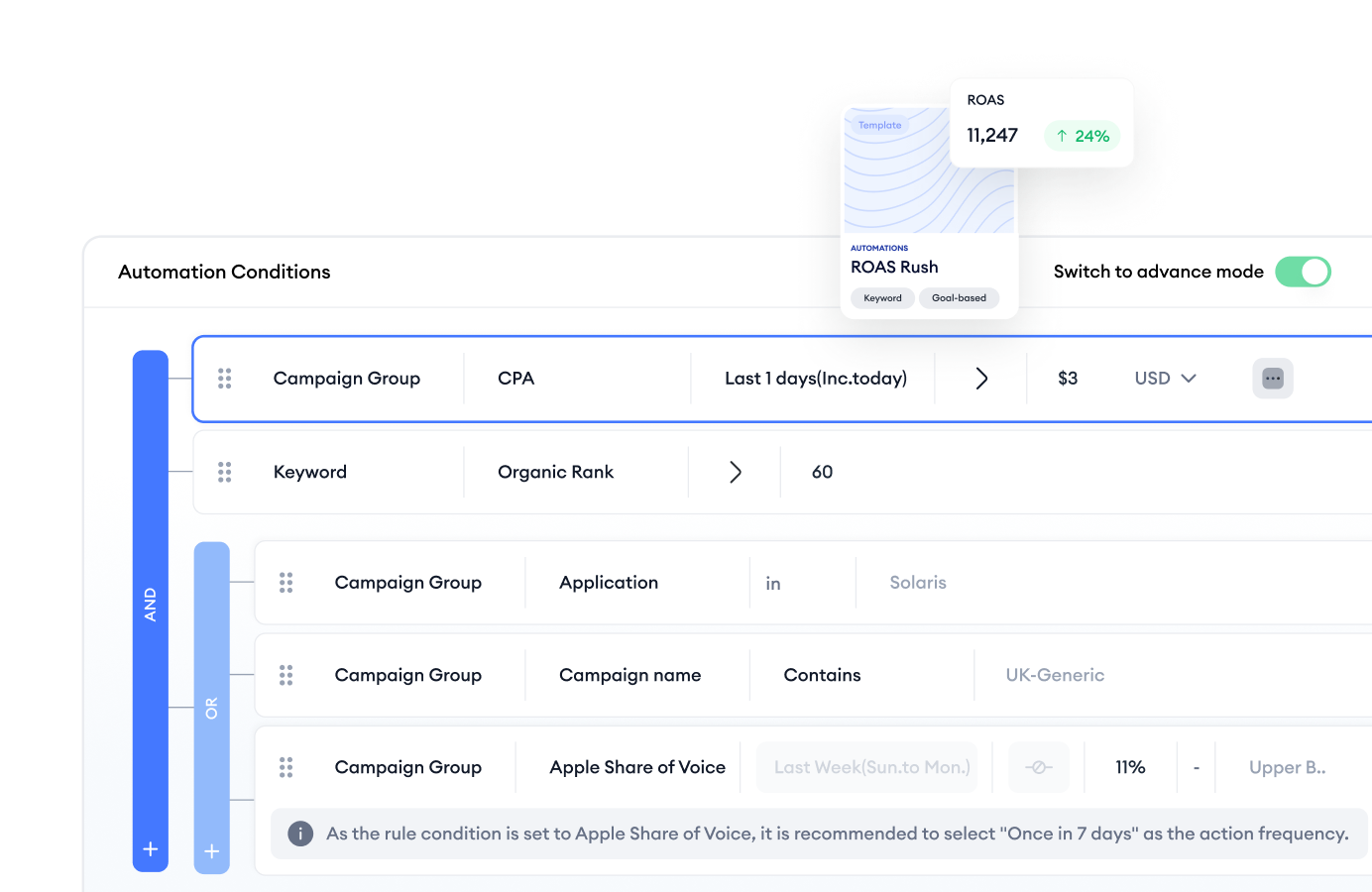
This can be useful when discovery campaigns, broad match, or Search Match generate many search terms that need regular review. Instead of manually checking every term one by one, teams can use automation to catch budget-wasting patterns faster, while still reviewing the rules and logs to make sure the account structure stays clean.
7. Set bids based on intent and performance
Do not use the same bid logic for every keyword. When using the Manage Bids strategy in search results campaigns, set bids based on keyword intent, match type, and performance. Important exact match keywords usually deserve stronger bids because they are closely tied to your core search intent. Broad match keywords and Search Match ad groups can support discovery, but they should usually be managed more carefully until performance is proven.
Raise bids when relevance and conversion performance are strong. Be more careful with broad, unproven, or unstable terms. CPT matters, but it should be reviewed together with conversion rate, CPA, spend, and downstream user quality.
8. Align custom product pages with user intent
Custom product pages can make ads more relevant when they are aligned with the audience, keyword theme, or campaign goal. For Today tab, Search tab, and search results ads, advertisers can use custom product pages and, where available, deep links to create a more relevant path from ad tap to app experience.
For example, a fitness app may use different page messaging for “home workout,” “workout planner,” and “sleep meditation” keyword themes. The goal is simple: the ad and landing experience should match what the user is looking for.
9. Measure more than installs
Apple Ads reporting can help you monitor metrics such as impressions, spend, installs, and average CPA. But for many apps, installs alone are not enough.
If your app depends on subscriptions, purchases, bookings, sign-ups, level completions, or long-term retention, connect Apple Ads performance with post-install data. A mobile measurement partner can help show what users do after installing your app, so you can evaluate campaign quality beyond download volume.
MobileAction CMP supports MMP integrations with Adjust, AppsFlyer, Branch, Kochava, Tenjin, Singular, and Airbridge. With an MMP connected, teams can bring Apple Ads campaign data and post-install event data into one workflow, making it easier to review which campaigns, ad groups, keywords, or creatives are driving valuable users, not just installs.
This is especially useful when optimizing toward goals such as purchases, subscriptions, ROAS, or other in-app events. Keep in mind that MMP attribution methodology may differ from Apple Ads reporting, so use both data sources carefully when evaluating performance.
10. Use automation carefully
Apple Ads offers Maximize Conversions for search results campaigns, which uses Search Match and an auto-bidder to help drive tap-through installs toward a target CPA. This can reduce manual keyword and bid work, but it still needs clear goals, clean campaign structure, enough budget, and regular performance review.
For larger accounts, automation can also support the repeated work around reporting, bid changes, budget checks, keyword actions, negative keyword cleanup, notifications, and workflow consistency. MobileAction CMP’s Automations can help teams build rule-based workflows across Apple Ads placements and account levels, including campaigns, ad groups, ads, keywords, and search terms. Teams can use automations to change bids, adjust daily budgets, pause or activate entities, add keywords, add negative keywords, send Slack or email notifications, apply labels, and activate custom product pages when selected conditions are met.
Use automation as a control layer, not as a shortcut for weak strategy. Fix campaign structure, keyword logic, measurement, budget control, and review routines first. Then use automation to make repeated optimization work faster, more consistent, and easier to monitor through logs, labels, templates, and active or paused rule management.
Expert note
The best Apple Ads accounts are built around a simple learning loop: structure campaigns clearly, review search terms, control spend with bids and negatives, improve ad relevance with custom product pages, measure quality beyond installs, and use automation only where it supports better decisions.
Frequently asked questions
How much does Apple Ads cost?
Apple Ads cost depends on your placement, country or region, app category, audience, competition, budget, and bid strategy.
For Apple Ads Advanced, pricing is based on a cost-per-tap model. This means you pay when a user taps your ad, up to the maximum price you choose.
A simple way to monitor tap cost is:
Average CPT = Spend / Taps
To understand acquisition efficiency, also review CPA. In Apple Ads reporting, average CPA is calculated from spend and installs, depending on the reporting view you use.
A simple campaign-level formula is:
CPA = Spend / Installs
For example, if you spend $1,000 and drive 500 installs, your CPA is:
$1,000 / 500 = $2 CPA
A lower CPT does not always mean better performance. A campaign with cheaper taps can still have a higher CPA if those taps do not lead to installs. To manage cost more effectively, review CPT together with conversion rate, CPA, budget pacing, and post-install value where available.
How do I use Apple Ads?
Start with a clear goal, choose the right Apple Ads solution, and build a campaign structure that is easy to manage.
A practical beginner workflow is:
- Choose Apple Ads Advanced if you need control over placements, keywords, bids, budgets, and reporting.
- Use search results ads to reach users when they search for something specific.
- Separate campaigns by keyword theme, such as brand, category, competitor, and discovery.
- Use exact match for important keywords you want to control closely.
- Use broad match and Search Match to discover relevant search terms.
- Add negative keywords to prevent ads from appearing for searches that are not relevant to your app.
- Set max CPT bids based on keyword importance, competition, and performance.
- Use custom product pages when you want ad creative and landing experiences to better match keyword themes or audiences.
- Review key metrics such as impressions, taps, average CPT, installs, conversion rate, CPA, and spend.
- Use what you learn to improve campaign structure, keyword coverage, ad relevance, and App Store product page decisions.
The goal is not only to launch ads. The goal is to create a repeatable workflow for learning, improving, and scaling with control.
What is the best Apple Ads campaign structure?
A strong Apple Ads campaign structure separates campaigns by keyword theme and user intent. This makes performance easier to understand and optimization easier to manage.
| Campaign type | Purpose |
| Brand | Reach users searching for your app or company name |
| Category | Reach users searching for your app category, features, or use case |
| Competitor | Reach users searching for apps similar to yours |
| Discovery | Find new relevant search terms through broad match and Search Match |
Apple recommends using exact match for brand, category, and competitor campaigns. Discovery campaigns can use broad match and Search Match to identify new search terms that may later be added to your core campaigns.
This structure helps you manage bids, budgets, reporting, negative keywords, and custom product pages with more control.
How do Apple Ads and ASO work together?
Apple Ads and ASO can support each other when campaign learnings are used carefully.
Apple Ads can show which keywords, search terms, ad variations, and custom product pages are associated with taps, installs, and other performance signals. ASO can use those learnings to improve App Store positioning, metadata decisions, screenshots, messaging, localization, and product page conversion.
A practical workflow is:
- Use Apple Ads to test relevant keyword themes.
- Review search terms, taps, installs, conversion rate, CPA, and post-install performance where available.
- Move strong search terms into exact match campaigns.
- Consider relevant high-performing terms for ASO research.
- Use custom product pages to test messaging for important audiences or keyword themes.
- Apply the strongest learnings to the App Store product page strategy.
Do not copy every paid keyword into metadata. Use Apple Ads data as one source of evidence, then evaluate relevance, search demand, competition, and organic fit.
How does Apple Ads support app growth in 2026?
For app growth teams, Apple Ads can be a valuable channel for improving app discovery and driving downloads on the App Store. Because ads appear while users are searching, browsing, or considering apps, Apple Ads can help advertisers reach people closer to the moment of intent.
In MobileAction’s view, the impact of Apple Ads depends heavily on how campaigns are structured and managed. A strong account typically needs a clear campaign setup, relevant keyword coverage, appropriate bids and budgets, negative keyword management, consistent reporting, and ad creative that matches user intent.
That is why Apple Ads should not be viewed only as a paid install channel. When managed strategically, it can also help teams understand search demand, keyword relevance, product page messaging, and conversion opportunities across the App Store.
This handbook will serve as your roadmap, packed with emerging trends, valuable insights, and the best ASO tools & resources. It aims to help you stay ahead of the competition and enhance your app marketing strategy for substantial growth in 2025 and beyond.
Resources that you'll love










Grow your app on the App Store and Google Play Store with our solutions now